1 SPEAKING Read a factfile about Cameron Brian. Which piece of information do you fi nd most interesting? Say why.
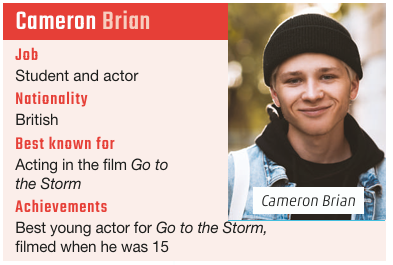
Answers Students’ own answers
2 Read an excerpt from an article about Cameron. What is surprising about him?
Like many people who watched the lm Go to the Storm, I left the cinema 1 wanting to know more about the main star, the young-actor Cameron Brian. I later read about how the 15-year-old boy starred in the lm although he had dyslexia, which means he nds it hard to read, 2 leaving me amazed that he was so good in the film. 3 After reading about his life growing up in London, I realised that his own childhood was similar to the boy in the lm – both grew up in a poor part of the city but wanted to do better in life. Cameron Brian has also starred in other lms and appeared in a series on British TV.
Suggested answers
he has dyslexia so fi nds it hard to read yet he starred in a film; his childhood was very similar to the life of the boy in the film
3 Match the underlined examples of participle clauses in the text (1–3) with the participle clauses (a–c).
a □ Showing a sequence of events.
b □ Showing that two things happened at the same time.
c □ Showing the result of an action.
Answers a 3 b 1 c 2
4 Complete the second sentence so that it means the same as the first.
1 Because he has won several awards, the actor’s work is well-known.
(Having ...)
2 As they are best friends, Asma and Dalia enjoy working together.
(Being ...)
3 The actor didn’t expect the play to be so successful, and didn’t realise it would run for seven seasons.
(Not expecting ...)
Answers
1 Having won several awards, the actor’s work is well-known.
2 Being best friends, Asma and Dalia enjoy working together.
3 Not expecting the play to be so successful, the actor didn’t realise it would run for seven seasons.
5 Study Watch Out! and rewrite the sentences, replacing the underlined section with a participle phrase. Make any changes necessary.
WATCH OUT! To use a participle clause, the subject of both clauses needs to be the same, e.g. I left the cinema wanting to know more about the main star. … (I left the cinema, and I wanted to know …) If each clause has a different subject, we will need to make some changes to make the meaning clear, e.g. The man, having shut the door in my face, walked o down the p
1 Cameron starred in the film although found it difficult how to read.
2 Cameron has been in more than one fi lm and appeared in a British TV programme.
3 Cameron won an award and got the best actor prize.
4 Cameron wanted to do better in life, so he learnt to act.
Answers
1 Cameron starred in the film despite finding it diffi cult to read. 2 Cameron has been in more than one fi lm, also appearing in a British TV programme. 3 Cameron won an award, getting the best actor prize. 4 Wanting to do better in life, Cameron learnt to act.
6 Combine the two sentences, using a participle clause.
1 I didn’t realise what time it was. I missed the train.
2 I lost my key. I couldn’t get in the house.
3 I had been standing for hours. I felt very tired.
4 I knew what had happened. I wasn’t surprised
Answers
1 Not realising what time it was, I missed the train. 2 Having lost my key, I couldn’t get in the house. 3 Having been standing for hours, I felt very tired. 4 Knowing what had happened, I wasn’t surprised.