Unit 6
Reading: Page 66, exercise 4
4 Read the report again. Complete the text with these sentences.
A. Trade with the EU and North Africa, in particular, is likely to grow.
B. However, the majority (65%) of the economy is dominated by services, mostly travel and tourism.
C. Not surprisingly, two of Jordan's largest exports are chemicals and fertilisers.
D. For that reason, Jordan has to import oil and gas for its energy needs.
Answers:
1. C 2. B 3. D 4. A
Comprehension: Page 67, exercise 5
5 Read the report again and answer the questions.
1 What does the article suggest that many of Jordan’s fertilisers are made from?
2 Why does Jordan import a lot of oil and gas?
3 Which country supplies Jordan with most of its imports?
4 Why is trade with the EU and North Africa likely to grow?
Answers
1 They are made from potash and phosphate, as this is what Jordan is rich in.
2 Jordan imports a lot of oil and gas because it does not have enough of its own reserves for the needs of the country.
3 Saudi Arabia
4 Trade with these areas is likely to grow because Jordan has signed trade agreements with both areas.
Vocabulary: Page 67, exercise 6
6 Choose the correct word(s) to complete the text about exports from Jordan to the European Union.
| exported had exported imported was exported was imported were exported |
| Jordan has sold goods to the EU for many years. In fact, it (1) ....................... many products to the EU even before the 1997 CE trade agreement was made. The chart shows goods that Jordan (2)............................ to the EU in 2011 CE. Chemicals accounted for about 37.2% of its exports. Jordan also exported a lot of metals (16.8%) as well as manufactured goods (11.2%). Smaller amounts of food, live animals and machinery (3) ..................... to the EU. The section called „other‟ included sales of goods related to forestry and mining. |
Answers
1 had exported 2 exported 3 were exported
Speaking: Page 67, exercise 7
7 Exercise 6 analyses the chart of exports from Jordan to the EU. Use this paragraph to note down ideas about the second chart. Then, discuss the chart with a partner, analysing exports from the EU to Jordan.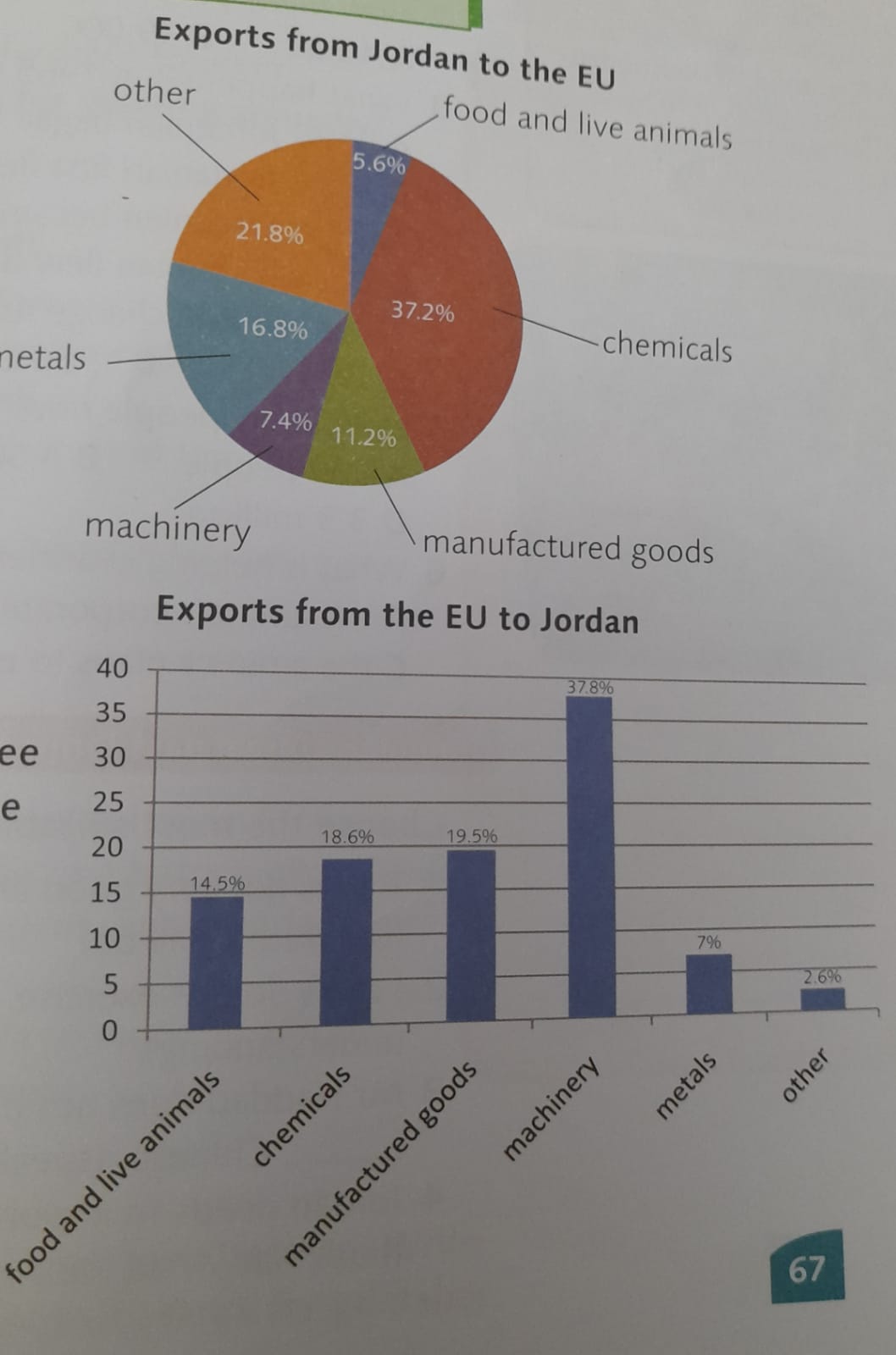
Answers
Students’ own answers
Speaking: Page 68, exercise 1
1 Work in pairs. Discuss these questions.
1 Have you ever travelled by plane?
2 Where do you think you can fly to in the world directly from Jordan?
3 Do you think there are more or fewer planes in the sky today? In your opinion, is this a positive or a negative development? Why?
Answers
Students’ own answers
Listening: Page 68, exercise 2
2 Listen to an interview with a former pilot from Royal Jordanian Airlines, and answer the questions.
1 How many planes did the airline have in 1964 CE?
2 Who did the airline help in 2014 CE, and in what way?
|
Audioscript Mr. Khatib: Yes, its revenue is about 750 million Jordanian dinar, but the company has a good record of corporate responsibility. |
Answers
1. two 2. It helped 200 orphans by taking them to visit the Children’s Museum of Jordan.
Comprehension: Page 68, exercise 3
3 Listen again and choose the correct answer.
1. What was the destination of the airline’s first flight?
A Beirut B Cairo C Kuwait City D Amman
2. How many people did the airline carry in 1964 CE?
A 4,200 B 39,000 C 87,000 D 3.3 million
3. What happened in 1965 CE?
A Royal Jordanian began to use modern jets.
B Royal Jordanian first flew to Europe.
C Royal Jordanian became the main airline in the Arab world.
D Royal Jordanian flew directly to New York.
4. When did Alia change its name to Royal Jordanian Airlines?
A 1977 CE B 1986 CE C 1999 CE D 1965 CE
5. How many people does Royal Jordanian employ today?
A 600 people B 4,500 People C 750 million people D 3.3 million
6. What is helping charities an example of?
A the airline’s corporate responsibility B the airline’s revenue
C the airline’s plans to expand D the airline’s wish to help orphans
Answers
1 A 2 C 3 B 4 B 5 B 6 A
Pronunciation: Sentence stress (2):
Page 69, exercises 5 and 6
|
Speaking strategies Using correct sentence stress
|
5 Listen to this sentence said in four different ways. Match each one to its implied meaning.
The first ever Alia flight was in 1963 CE.
a There were other flights before 1963 CE, but not Alia flights.
b Alia’s first flight was not in 1964 CE.
c There were no Alia flights at all before 1963 CE.
d Alia did other things before its first flight in 1963 CE.
Audio script
1 The first ever Alia flight was in 1963 CE.
2 The first ever Alia flight was in 1963 CE.
3 The first ever Alia flight was in 1963 CE.
4 The first ever Alia flight was in 1963 CE.
Answers
1 c 2 a 3 d 4 b
6 The word in bold in each sentence indicates the stress. Say the sentences. How does the meaning of each sentence differ?
a. I retired when I was 60, which was in 1999 CE.
b. I retired when I was 60, which was in 1999 CE.
c. I retired when I was 60, which was in 1999 CE.
d. I retired when I was 60, which was in 1999 CE.
Answers
a. It was I, not someone else, who retired.
b. I did other things when I was 60, but this is when I retired.
c. I was 60 When I retired, not another age.
d. It was in 1999 CE when I retired, not another year in the 1990s.
Speaking: Page 69, exercise 7
7 Work in pairs and discuss these questions.
1 Which are the most interesting places that you have visited in Jordan?
2 Which do you think are the best places for tourists to visit in Jordan?
3 How important do you think tourism is to the Jordanian economy?
Answers
Students’ own answers
Listening: Page 69, exercise 8
8 Listen to a radio programme about Jordan’s tourism industry. At what rate is the tourism sector growing annually?
| Audio script In today’s business programme, we look at one of the most successful businesses in Jordan, and that is Jordan itself! Thousands of tourists want to visit the country each year, thanks to its culture, historical sites and beaches. This is good news for all of us. Tourism is one of the most important sectors of the economy. The country receives more than three million tourists a year, and they generate about three billion dollars of revenue. This contributes thirteen per cent of the country’s Gross Domestic Product. Around six per cent of the country’s workforce are employed in tourism, including hotel and restaurant staff, guides and people working for tour companies. Jordan already has a good tourist infrastructure so that visitors can easily travel to the main sites. However, the Ministry for Tourism and Antiquities is working hard to promote Jordan as a tourist destination for both the domestic and overseas market. To do this, money has been invested in some of Jordan’s most historic cities, including Salt, Jerash, Karak and Madaba. So which places do tourists prefer when they visit Jordan? Some would rather go to historic sites such as Jerash and Petra. Others prefer to see natural attractions such as the Dead Sea or the desert of Wadi Rum. Others like the beaches and diving at Aqaba. The ministry wishes that people would visit all areas of the country and not only these established destinations. Loans and grants are being given to other areas of the country to promote different types of tourism. For example, tourists can enjoy adventure sports such as rock climbing, hiking and scuba diving. Shopping is also being promoted for tourists in Amman, Aqaba and Irbid. Jordan’s economy is growing by about three per cent annually, but the tourism sector is growing at more than 10 per cent annually. No wonder tourism is such an important business. |
Answer
more than 10 per cent annually
Comprehension: Page 69, exercise 9
9 Listen again and answer the questions.
1 What percentage of the country’s workforce is in tourism?
2 Why has money been invested in some historic cities?
3 Why do tourists usually like to go to Aqaba?
4 Why have loans and grants been given to areas of the country that tourists do not usually visit?
5 What examples are given of the different types of tourism that are being promoted?
Answers
1 About six percent of the workforce is in tourism.
2 It has been invested in order to help to promote Jordan as a tourist destination.
3 They like going there because of the beaches and diving.
4 The government wants tourists to visit these places and so they are trying to promote different kinds of tourism.
5 Rock climbing, hiking, scuba diving and shopping are being promoted as adventure sports for tourists.
Speaking: Page 69, exercise 10
1 0 Work in pairs and give your preferences and opinions.
1 Would you prefer an activity holiday or a beach holiday? Why?
2 Would you rather go to a natural attraction or a historic city? Why?
3 In your opinion, should more money be spent on tourist facilities? Why/Why not?
4 If you worked in tourism, would you prefer to work for a hotel, restaurant, tour company or something else?
Answers
Students’ own answers