Unit 10
Lesson 3
Student’s Book pages 80 and 81
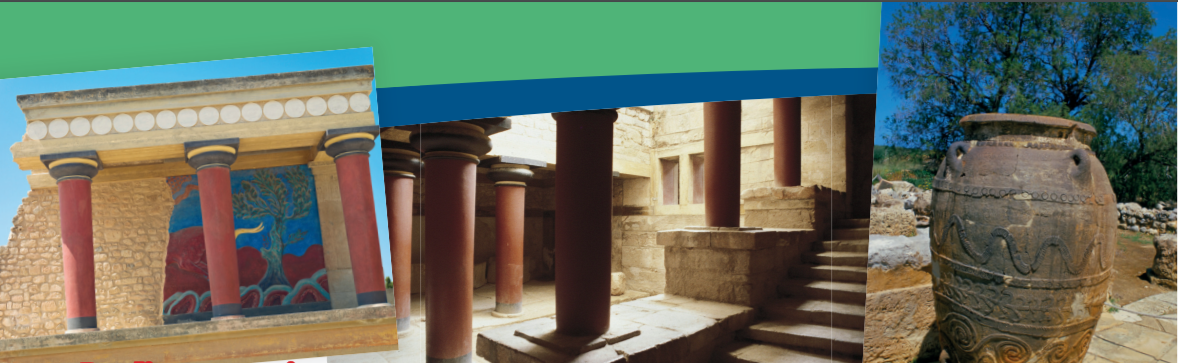
Reading
1 Look at the photographs. What do you think you are going to read about? Choose the correct topic.
a the museums of Crete
b the ancient people of Crete
c the people living in Crete today
Reading strategies
Reading texts about unfamiliar topics
• Before you read, find out as much as you can about the subject.
• Ask your partner questions about the subject.
• During reading, try to visualise the topic. Relate it to what you know.
• After reading, ask yourself what you have learnt. Find the main ideas of the text.
Answers
Students’ own answers
2 DW Read the words in the box. Which words are related to the Minoan civilisation? Check the meaning of any words you don’t know in the Activity Book glossary or in a dictionary.
|
cattle deposits navy paved roads piece together |
Answers
cattle, paved roads, navy
3 Read the article and check your answer to exercise 1.
The Minoan civilisation ruled the Mediterranean island of Crete for 1,500 years, until it was destroyed in 1450 BC. The Minoans built the first paved roads in Europe and introduced running water. They had a powerful navy, which might have been why they were such a strong civilisation for so long.
For many years, people have been trying to find out why this developing civilisation might have disappeared. Even after Crete was hit by a large earthquake around 1,700 BC, the Minoans rebuilt their cities. So what caused their civilisation to end?
Many experts say that the end of the Minoan civilisation might have been caused by the eruption of a volcano on the nearby island of Santorini, almost 3,500 years ago.
However, at Knossos in Crete, scientists have been examining deposits of ash, marine species, cattle bones and seashells in the soil. How could these deposits have got there? The only answer is that they must have been deposited in Crete by a tsunami.
Experts have now pieced together a possible explanation of what might have happened. They believe that several tsunamis might have hit the northern and eastern shores of the island, every thirty minutes due to the eruption of the volcano on Santorini. It must have been a terrifying experience for the Minoans living there!
Answers
b
The text
The Minoan civilisation ruled the Mediterranean island of Crete for 1,500 years, until it was destroyed in 1450 BC. The Minoans built the first paved roads in Europe and introduced running water. They had a powerful navy, which might have been why they were such a strong civilisation for so long.
For many years, people have been trying to find out why this developing civilisation might have disappeared. Even after Crete was hit by a large earthquake around 1,700 BC, the Minoans rebuilt their cities. So what caused their civilisation to end?
Many experts say that the end of the Minoan civilisation might have been caused by the eruption of a volcano on the nearby island of Santorini, almost 3,500 years ago.
However, at Knossos in Crete, scientists have been examining deposits of ash, marine species, cattle bones and seashells in the soil. How could these deposits have got there? The only answer is that they must have been deposited in Crete by a tsunami.
Experts have now pieced together a possible explanation of what might have happened. They believe that several tsunamis might have hit the northern and eastern shores of the island, every thirty minutes due to the eruption of the volcano on Santorini. It must have been a terrifying experience for the Minoans living there!
Comprehension
4 Read the text again and answer the questions.
1 What do the underlined words refer to?
2 How did the Minoans contribute to the development of civilisation? 3 Why is the disappearance of the Minoan civilisation a mystery?
4 What evidence made the experts believe that Crete was hit by tsunamis?
5 If a civilisation from our days disappeared all of a sudden, what kind of evidence do you think it would leave behind it?
6 Would the disappearance of the civilisation mentioned in question 5 above be a mystery for experts hundreds of years later? Why / Why not?
Answers
1 it (line 2): the Minoan civilisation;
They (line 3): the Minoans;
they (line 16): the deposits
2 The Minoans contributed to the development of civilisation by introducing paved roads and running water.
3 Its disappearance is a mystery because they were a very strong civilisation for a long time, even rebuilding their cities after an earthquake.
4 Scientists believe that tsunamis must have hit the island because deposits of ash, marine life, cattle bones and seashells have been found in the soil.
5 Suggested answer: I think a civilisation would leave behind examples of recent technology and also everyday life.
6 Suggested answer: I think it might be difficult to understand, years later, because daily life will have changed a lot since it was destroyed.
Unit 10
Lesson 3
Activity Book page 54
Reading
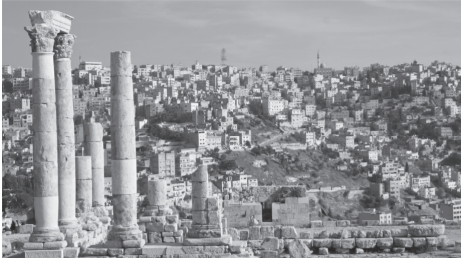
5 This is a photograph of ancient ruins as well as modern-day buildings. Which city is this? What do you think the photograph suggests?
Answers
Students’ own answers
6 Read the following text and check your answers to exercise 5.
Several different peoples have inhabited the city of Amman since antiquity. The earliest settlement was recorded to date from around 7,000 BCE. The peoples left a lot of remains behind, which can tell us a great deal about their culture.
Among the remains is the Amman Citadel or Jabal al-Qalaa. The citadel has witnessed the rise of many different empires throughout the centuries. Even though archaeologists have been studying the citadel’s structures, tombs, walls and stairs, a lot of the remains are still unexcavated.
The Amman Citadel is also the site of the Jordan Archaeological Museum, which is home to a collection of artefacts from the citadel, as well as objects from other Jordanian historic sites.
This photo of Amman represents a mixture of ancient Amman and modern Amman. It makes us reflect on how much an ancient civilisation can affect our modern-day culture.
Answers
The photo shows modern buildings alongside an ancient citadel in the city of Amman. It suggests the importance of ancient history in our modern-day culture.
7 Answer the following questions
1 What do you think the citadel’s structures, tombs, walls and stairs might tell us about the civilisations back then?
2 Do you think a country’s remains and ruins should be preserved? Why / Why not?
3 How do you think an ancient civilisation can affect modern-day culture?
4 Name other archaeological sites in Amman. Have you been to any of them? If so, what was so impressive about them? If not, which sites would you like to visit?
Suggested answers:
1 The citadel’s structures, tombs, walls and stairs might tell us about how people lived in ancient civilisations.
2 A country’s remains and ruins should be preserved because it is important to know about history.
3 Students’ own answers
4 Students’ own answers
Unit 10
Lesson 4
SB page 81
Vocabulary: Natural disasters
5 Complete the following paragraph with the words related to natural disasters from the box.
|
Earthquake volcano flood tsunami tornado |
Natural disasters happen all around the world; they can sometimes destroy cities and whole civilisations. A (1)…………………….. happens when it rains too much. A large amount of water would overflow from a river or from a dam. Another natural disaster is the (2)…………………… , which is a powerful, destructive windstorm. That’s when violent winds rotate and destroy everything around them. A (3)…………………. is a huge wave in the ocean that causes terrible damage to the land. This disaster can be caused by an (4)……………………….. , when the earth shakes from deep inside, which in turn can be caused by the eruption of a (5)……………………… .
Answers
1 flood
2 tornado
3 tsunami
4 earthquake
5 volcano
Speaking
6 Look at the objects found in a person’s bag. Work in pairs. Make sentences about the person using might (not) have / must (not) have / could (not) have.
Speaking strategies
Speculating using evidence
• You can start your conversation by asking your partner ‘What do you think happened?’
• Remember to speculate using past modals as well as ‘maybe’,’possibly’, etc.
• If you disagree with your partner’s speculations, you can say ‘Oh, really?’, ‘Don’t you think ...?’, ‘I’m not sure I agree with you.’
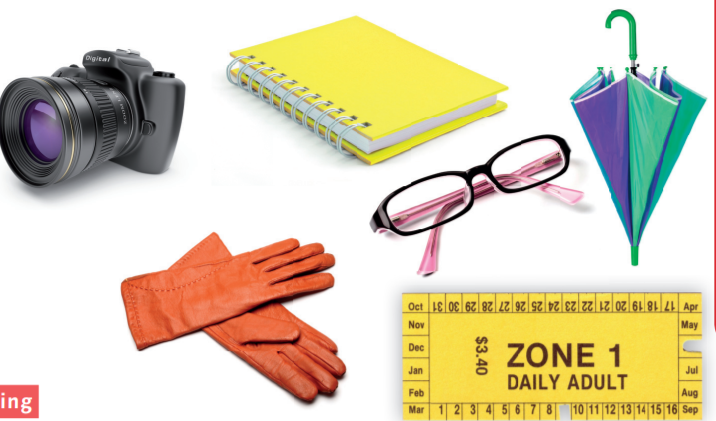
The person couldn’t have been a child, because there is an adult train ticket.
Suggested answers
The person couldn’t have been a child because there is an adult train ticket.
The person could have been sightseeing because there is a camera.
The person might have been going to a business meeting because there is a notebook.
The person must have had poor eyesight because there is a pair of glasses.
The person couldn’t have been travelling in the summer because there are gloves and an umbrella.
Writing
7 Imagine that you were born in another part of your country, or even another country. Write a paragraph about the things that would have been different about your life. Use could (not) have / might (not) have.
I might not have learnt the same first language as I do now.
Answers
Students’ own answers
Unit 10
Lesson 4
Activity Book page 54
Grammar
8 Imagine that you had been born 100 years ago. Write sentences about how your life would have been different. Use the modal verbs shown and add one more of your own.
1 (might have) I might have travelled to school on a horse instead of by car.
2 (could have) ………………………………………………..
3 (couldn’t have) ………………………………………………
4 (might not have) ……………………………………………..
5 (might have) …………………………………………………
6 ( ) ………………………………………………….
Suggested answers:
1 I might have travelled to school on a horse instead of by car.
2 I could have worked from the age of 10.
3 I couldn’t have had the chance to watch television.
4 I might not have been able to read.
5 I might have had a less healthy diet.
6 I would have only read books instead of e-books.
Unit 10
Lessons 5+6
SB pages 82 and 83
Listening
1 What do you know about Pompeii? Answer the questions.
1 Where was it?
2 What was the population of the city?
3 When was the city destroyed?
4 How was the city destroyed?
Answers
Students’ own answers
2 Listen to a tour guide showing tourists around the city. Check your answers to exercise 1.
Audioscript
Pompeii was once a very busy commercial city near the modern city of Naples in Italy and about 20,000 people lived here. Then, on 24th August in the year 79 CE, hot ash from the volcanic eruption of Mount Vesuvius buried the entire city. In the 1600s, archaeologists rediscovered the city’s ruins under the ashes and started learning about the life that the people here must have lived.
This is the main street, Porta Marina. If you look down, you can see the stone rings where ships were tied to the dock. The sea must have come right up here in those days. These streets must have been fi lled with shops and stalls. There might have been chariots driving here, just where we are walking now.
It’s interesting to look up at Mount Vesuvius from this main square, the Forum. Of course, the people couldn’t have known that they were in danger of a volcanic eruption, because Vesuvius hadn’t erupted for more than 1,000 years.
Here is an ancient take away restaurant! These holes in the counters held the pots for food. Now here we are at what must have been the finest house in Pompeii, the House of the Faun, with the lovely bronze statue of an animal in the garden.
These four big stone cylinders were once the bakery and the mill. The brick oven looks like a modern-day pizza oven. Lastly, we arrive at the amphitheatre. During Roman times, there might have been up to 5,000 people here, being entertained.
Answers
1 near Naples in Italy
2 about 20,000
3 24th August, 79 CE
4 It was buried by hot ash from a volcanic eruption.
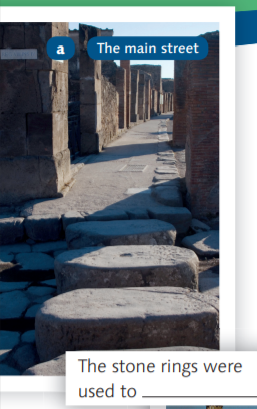
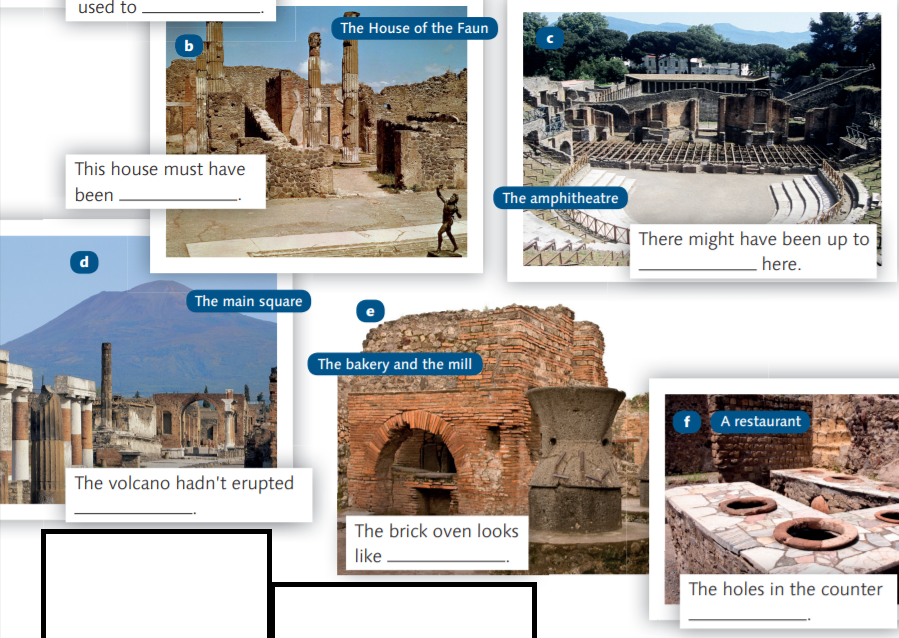
3 Look at the photographs a–f. What can you see? Listen again. Place the photographs in the order that each is mentioned.
Answers
1 a 2 d 3 f 4 b 5 e 6 c
4 Listen again. Complete the sentences under each photograph.
Answers
a tie ships to the dock
b the finest house in Pompeii
c 5,000 people
d for more than 1,000 years
e a modern-day pizza oven
f held the pots for food
Research box
What are the criteria for a place to become a World Heritage Site? Choose the three most important ones.
Answer
Students refer to the Unesco website for World Heritage Site criteria.
Speaking
5 Have you ever visited an archaeological site? What did you see there?
Answers
Students’ own answers
Quotation
Read the quotation. Do you agree with it? Why / Why not? Translate the quotation into Arabic.
The past is the future of the present.
Japanese proverb
الماضي هو مستقبل الحاضر.
Vocabulary: Everyday traditions in the past
6 What do you think the daily lives of your ancestors in Jordan were like? Discuss with a partner.
Answers
Students’ own answers
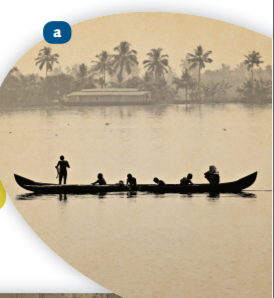
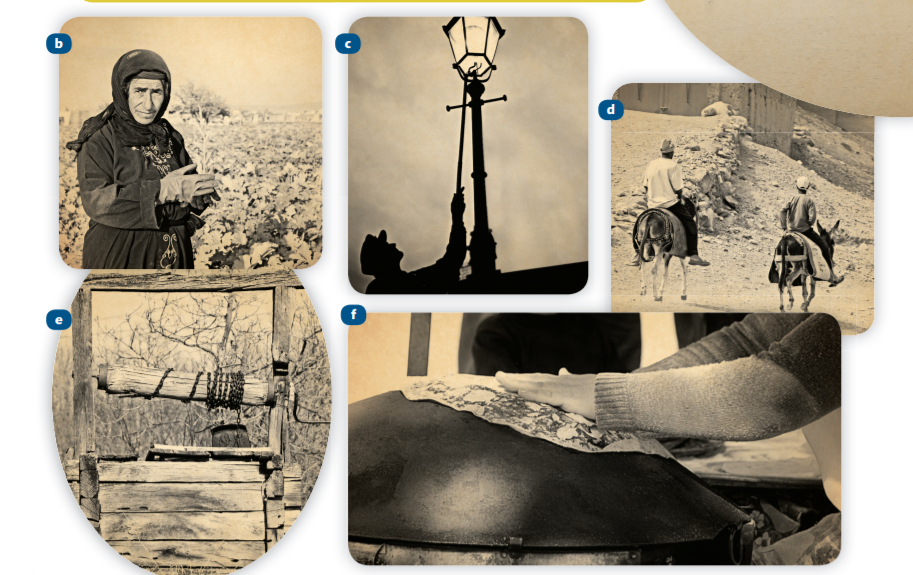
7 Match the expressions in the box with the correct photograph. Which expressions are traditions related to food?
|
riding donkeys and horses lighting streetlamps making bread fishing providing water harvesting the crops |
Answers
a fishing
b harvesting the crops
c lighting streetlamps
d riding donkeys and horses
e providing water
f making bread
The expressions related to food are making bread, fishing and harvesting the crops.
Speaking
8 Look at the pictures above and answer the following questions in pairs..
1 Which ones were probably not everyday customs in the past in Jordan? Justify your answer.
2 Describe the six pictures and say what you think is happening in each one. Use could (not) have / might (not) have / must (not) have.
Answers
Students’ own answers
Writing
.9 Choose two everyday activities from Jordan’s past. Write a paragraph about each one. Use could (not) have / might (not) have / must (not) have
Answers
Students’ own answers
?10 Share your work with the class. Who has the most interesting ideas about what life might have been like back then
Unit 10
Lessons 5+6
Activity Book pages 55 and 56
Reading
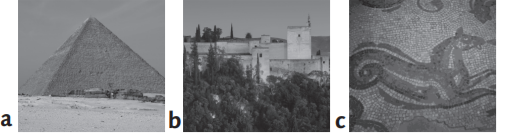
9 Match postcards 1 and 2 with the pictures a–c. You do not need one of the pictures.
1 Hi Rakan
This is a section from the mosaic floor at the Roman baths in Bath, England, where I am staying with my family. You can see part of a sea horse. The colours have faded now, but the mosaic must have been stunning during Roman times. Men who visited the baths might have first gone in the hot room, then sat in the cold room before having a dip in the swimming pool. I suppose the baths were used a bit like our leisure centres today!
See you soon
Issa
2 Hi Malak
We have just been to see the pyramids near Cairo, Egypt. The Great Pyramid, which you can see on this postcard, is absolutely huge! It must have taken a lot of people to build it. The guide told us that as many as 100,000 people might have been needed. It must have been hard work pulling those blocks. The Ancient Egyptians built the pyramids by the River Nile, so they could transport the stone blocks more easily to the building site. The pyramids were made to bury the Pharaohs of Egypt and to store their belongings, but thieves have now taken a lot of the treasure from the tombs.
See you soon
Sana
1 c 2 a
Writing
10 Write a postcard from an archaeological site. Use could (not) have, might (not) have or must (not) have. Mention the following:
• where it is
• which civilisation lived there
• a brief description of what you have seen
• what you think of it
Answers
Students’ own answers
11 Write five sentences about the tool in the picture below, using the modal verbs in exercise 10.
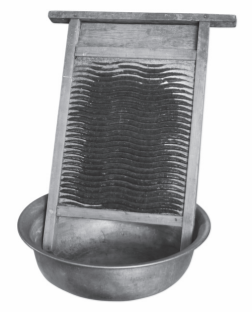
Suggested answers:
1 It could have been used for washing clothes.
2 It might have been used for grating lemons.
3 It can’t have been used for cutting bread.
Writing: A discovery article
12 Write a newspaper article about the discovery of an ancient civilisation. You should imagine this civilisation.
1 Where was the site found? Who found it and how?
2 Describe the site. Include the following:
• Who the site might have belonged to?
• How the artefacts found might have been used
• What language the inhabitants spoke, what food they ate and what traditions they had • What might have happened to the civilisation that the site belonged to?
13 Now write your article.
14 Read your article to the class. Whose civilisation is the most exciting? Why?
Page 56, exercises 12–14 Students’ own answers