Unit 8
Lessons 3 + 4
SB pages 66 and 67

Speaking
1 Which newspapers or magazines do you read? What kinds of story interest you most?
Answers
Students’ own answers
Vocabulary: Parts of a newspaper
1 Complete the book descriptions with the words in the box. You may need to do research on the Internet, in the school library or in a public library to know some of the answers.
|
article byline caption headline lead story masthead |
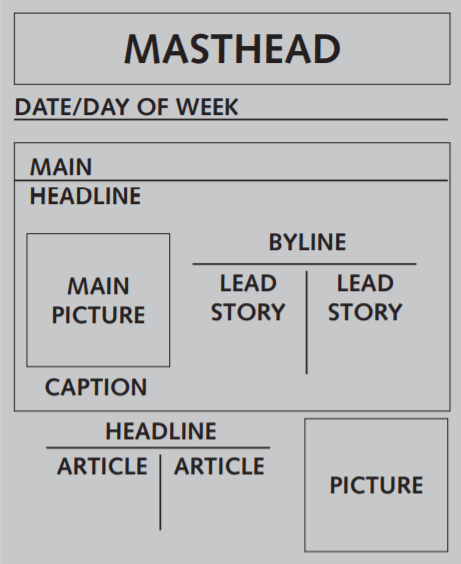
Answers
Students’ own answers
Listening
3 Listen to an interview with a young journalist about his work. Which of the words in exercise 2 does he mention?
Audioscript
Presenter: Sami is fifteen. He’s a Jordanian student at a school in London, but in his free time, he writes for a newspaper! Sami, tell us about the writing that you do.
Sami: I’m a member of an online newspaper where all the journalists are young people. We investigate stories and research topics that we think will interest people our age.
Presenter:How did you become a journalist?
Sami: Well, I was interviewed for a news story by another journalist. He was doing a story about children whose parents were immigrants in London. It ended up being the lead story of the newspaper.
Presenter: What kind of stories have you worked on?
Sami: I’ve done lots of different stories and I’ve made videos as well. I’ve also made a radio programme about young people and the food that they eat.
Presenter: What do you enjoy most about being a journalist?
Sami: I like the way that investigating issues makes you think about things more deeply. It has opened my mind to things that I didn’t know about, and it has given me a lot of confidence. Besides, seeing my name as the byline in an article is really rewarding.
Presenter: How can people read your work?
Sami: They can go to our website. We’ve also got a few magazines in print.
Presenter: Do you think you’ll work in journalism one day?
Sami: I hope so! I’d really love to report on issues all over the world. I think journalists have a very responsible job. It’s their role to tell people about things that are happening all over the world.
Answer
He uses the words lead story, byline and article.
Speaking
4 Listen again and answer the questions.
1 How did Sami first become involved with the newspaper?
2 How has being a journalist changed Sami’s personality?
3 How can people read the work of the young journalists?
4 Why does Sami think that journalists have an important job to do?
5 Do you think a journalist’s job is important? Why / Why not?
Answers
1 He was interviewed by a journalist from the newspaper.
2 It has made him think about things more deeply, and it has opened his mind to things that he didn’t know about and given him more confidence.
3 It is available on their website, and they also have a few magazines.
4 They have to tell people about things that are happening all over the world.
5 Students’ own answers
Quotation
Read the quotation. Do you agree with it? Why / Why not? Translate the quotation into Arabic.
The single biggest problem in communication is the illusion that it has taken place.
George Bernard Shaw (1856 CE–1950 CE)
المشكلة الكبيرة والوحيدة في التواصل هي التوهم بأنه موجود
Reading
5 Work in pairs. Look at the photographs on this page. What were your favourite leisure activities when you were a child?
Answers
Students’ own answers
6 Read the newspaper article. Identify the parts of a newspaper that are presented.
Fifty things to do before you are twelve
Emily Johnson
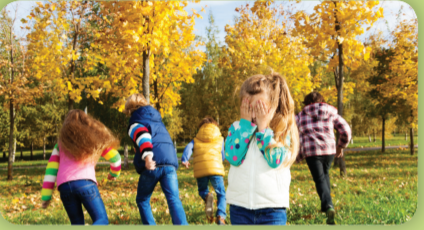
Think back to your childhood: playing house, cooking on a campfire and flying a kite. Are these things that you had done by the time you were twelve? If not, you’ve missed out on some important experiences, according to a new report.
The report contains a list of activities that children should experience so that they learn about how people communicate with each other and with nature. The report has been written to try to limit the amount of time that children are spending indoors and on computer games these days. Volunteers were asked to contribute their favourite childhood memories to the list, and from the 400 suggestions, a short list of fifty was compiled.
On the list were these activities:
catching fish with a net
eating an apple straight from the tree
looking for treasure on the beach
playing hide and seek
running around in the meadow
exploring rock pools at the seaside
The report says that many adults could remember a different type of childhood: one in which they had more freedom than children do these days. The author of the report says that she and other colleagues felt that children today hadn’t been given the chance to experience nature and learn about the world and human relationships in the same way.
Answer
The parts of the newspaper that are presented are the headline, the byline, the caption and the article.
Comprehension
7 Read the article again. Decide if the sentences are true or false. Correct the false sentences.
1 Playing house, cooking on a campfire and flying a kite are inessential experiences for children.
2 The report was written to encourage children to do more outdoor activities.
3 Children in the past did the same activities as children do now, but they had more freedom.
Answers
1 False: Playing house, cooking on a campfire and flying a kite are important experiences for children.
2 True
3 False: Children in the past did different activities to children now
Speaking
8 Work in pairs. Read the list of activities again. Which of those on the list had you experienced before you were twelve? What other outdoor activities had you experienced? How do you think it has helped you become who you are today?
Answers
Students’ own answers
Writing
9 Think about your childhood. By what age had you learnt the skills in the box? Write a paragraph using the Past Perfect. Add other ideas of your own in another paragraph.
|
walk ride a bike read fly a kite write tell the time tie shoelaces add and subtract sums speak a second language |
By the time I was one, I had learnt to walk.
Answers
Students’ own answers
Unit 8
Lessons 3+4
Activity Book pages 45 and 46
Reading
5 Complete the following text about sign language with the words from the box.
|
deaf system communication gestures sign |
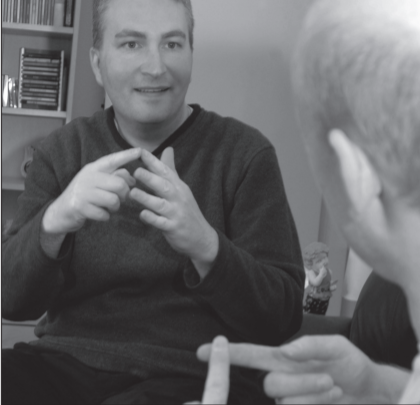
Sign language as we know it today originated in 1755 CE, when a Frenchman, Charles Michel de L’Epée, started a school for deaf people in Paris. His form of (1) consisted of gestures, hand signs and finger spelling. The L’Epée system was the first example of French (2) language.2 a detective novel
Around the same time, in 1778 CE in Germany, Samuel Heinicke was working on a (3) to teach deaf people how to read lips.
Meanwhile, in Britain, Thomas Braidwood opened the first school for the (4) in 1783 CE. At that time, students were using his form of sign language. Later, this became British Sign Language.
In 1816 CE, after he had seen people using sign language in Paris, an American, Dr Gallaudet, introduced the system in the USA. This, combined with various (5) that deaf people were still using in the USA at the time, formed American Sign Language.
Answers
1 communication
2 sign
3 system
4 deaf
5 gestures
6 Answer the following questions about sign language.
1 Write a definition of sign language using all the words in the box from exercise 5 in one sentence.
2 Which countries introduced sign language in the 18th century?
3 Do you think sign language is as practical and easy as spoken language? Why / Why not?
4 Create your own sign language for the following sentence: “I like reading a book before I sleep.” Share this sentence with a partner. Did you express it the same way?
1 Suggested answer: Sign language is a system of communication designed for the deaf, which consists of gestures, signs and finger spelling.
2 France, Germany and Britain introduced sign language in the 18th century.
3 Students’ own answers
4 Students’ own answers
7 Write 8 sentences in the Past Perfect to say what Sara, Ahmad, Asma and Fawzi had and hadn’t done by the time they started school. Then write about you.
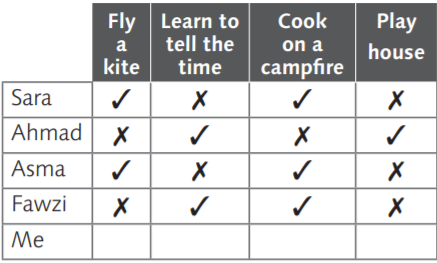
1 Sara had flown a kite, but she hadn’t learnt to tell the time.
2 Ahmad …………………………………….
3 Asma ……………………………………
4 Fawzi ………………………………..
5 Sara ………………………………….
6 Ahmad ………………………………….
7 Asma …………………………………….
8 Fawzi …………………………………………..
9 I ……………………………………….
Suggested answers:
1 Sara had flown a kite, but she hadn’t learnt to tell the time.
2 Ahmad had learnt to tell the time, but he hadn’t cooked on a camp fi re.
3 Asma had cooked on a campfire, but she hadn’t played house.
4 Fawzi had learnt to tell the time, and he had also cooked on a campfire.
5 Sara had cooked on a campfire, but she hadn’t played house.
6 Ahmad hadn’t flown a kite, but he had played house.
7 Asma had flown a kite, but she hadn’t learnt to tell the time.
8 Fawzi hadn’t flown a kite, and he hadn’t played house.
9 Students’ own answers
Reading
8 Read the text about how teenagers communicate with each other. Do you communicate with your friends like this?
A group of five teenagers are meeting in a restaurant. They haven’t seen each other for a few weeks because it’s the school holidays. Despite this, three of them are texting other friends, and the two others are playing games on their phones. They occasionally stop their phone conversations to chat for a few minutes, but most of their time together is spent in silence.
Does this scene sound familiar? Would you rather text than talk face-to-face? If you feel lost without your smartphone, chances are that you’re part of the teen technology revolution.
Every generation does things differently from their parents, but modern-day teenagers are revolutionising communication – and it’s not all positive. A survey found that 56 per cent of the teenagers asked would still prefer to hold an important conversation face-to-face, rather than on the phone. However, it also found that spending time on social network websites is now considered to be the same as socialising with friends.
The survey found that the main problem with technology and instant messaging is that ‘text speak’ (words abbreviated to single letters or symbols) has started to encroach upon other areas of their lives. They report accidentally using text speak in face-to-face conversations, in emails and even in school essays.
So, if you are lucky enough to be part of the technological generation, remember that technology is important, but friends, family and face-to-face conversations should be top of the list!
Students’ own answers
9 Answer the following questions about the text in exercise 8.
1 What are the teenagers in paragraph 1 doing? Why is this surprising?
2 In your own words, explain what the writer means by ‘the teen technology revolution’.
3 Does the writer feel that teenagers have the right balance between communicating via technology and talking face-to-face? Explain your answer.
4 What are the main problems that instant messaging has caused?
5 Do you agree with the writer’s recommendation in the last paragraph? Why / Why not?
1 The teenagers have met up to see each other, but they are not talking; instead they are sitting together at a table, playing on their phones. It is surprising because they have not seen each other for a fairly long time.
2 The writer means that teenagers now have access to the newest technology available, and they are using it in ways particular to teenagers. This means that their most important possession is their mobile phone.
3 The writer says that teenagers have made communication new and different, but that they do not have the right balance between technology and talking face-to-face. He says that they think that socialising face-to-face and communicating on social networks are the same thing
4 Instant messaging has caused problems such as use in more formal situations like emails, essays and face-to-face conversations.
5 Suggested answer: I agree with the writer that face-to-face conversations are more important because they help us to remember how to behave in public, and they also help us to feel more connected to the people around us, even more than technology does.
10 Imagine you are preparing a survey to ask adults about their relationship with technology and communication. What questions would you ask?
Answers
Students’ own answers
Unit 8
Lessons 5+6
SB pages 68 and 69
Reading
1 Look at the headlines of four articles. What do you think the articles have in common?
1 Holiday message is 50 years late
2 From mobile messaging to published book – communication becomes art
3 ‘Air-mail’ brings best friends together
4 Humans not alone in using sign language
Answers
All the articles are about communication.
2 Read the following articles. Match the headlines in exercise 1 with the articles A–D.
|
A A scientific research project has found that wild chimpanzees use at least 66 gestures to communicate with each other. After researchers had spent time with the animals in Borneo, they studied 120 hours of video they had recorded. They were looking for signs that the animals were using signals to communicate with each other. They looked to see if the chimps were looking at each other, in order to be sure that the gestures had a purpose, that is, to communicate something. If the animal didn’t respond to the gesture, the gesture was made over and over again, until there was a response. The results suggest that there is a common system of communication across the species. |
|
B A postcard sent from Florida has finally reached its destination in England. It had been posted in 1957 CE! This postcard had been addressed to someone working at an education centre. The building had once been a school. Staff at the education centre have been trying to find the addressee. The card, which appears to have been written by a grandparent, describes a trip to Florida, USA. He wrote that it had rained a bit that day but it was still hot. A spokesperson for the Post Office said that the postcard had probably been put back in a post box recently. He said that the mail was never in the sorting office for that length of time. |
|
C In 2001 CE, a girl called Laura Buxton, from Staffordshire, UK, wrote a message with her name and address on a helium-filled balloon. She then sent it into the air, where it disappeared. A few weeks later, the balloon landed nearly 200 kilometres away in southern England. The man who found it took it to his neighbours, the Buxtons, who had a daughter called Laura. They were surprised to learn that it was from another girl with the same name. The two girls got in touch with each other, decided to meet and became best friends. |
|
D An artist has kept all her text messages, and after twelve years, she had collected about 100,000 messages. She kept the first few messages because she enjoyed reading them over again – it was like a personal diary. It is also a record of history, covering world events. Every time a text message arrived, she saved the contents. She wrote them in notebooks when her phone ran out of space to store them. She eventually filled more than 60 notebooks. Then she started copying them on to her computer. The woman took her collection to a publisher, and the book has now been published and translated into several languages. |
Answers
1 B
2 D
3 C
4 A
Vocabulary: Means of communication
3 Underline all of the words that are forms of communication in the articles. One word has been done for you. Which words are written forms of communication?
Answers
gestures, signs, signals, response, postcard, card, mail, message, text messages, notebooks, phone, book Written forms of communication: postcard, card, mail, text message, notebook, book.
Comprehension
4 Read the articles again and answer the questions.
1 What do the words in bold refer to?
2 What are the four forms of communication in the four articles?
3 How do chimpanzees communicate with each other, according to the scientists in Borneo?
4 Why did the postcard take such a long time to be delivered?
5 Why did the man in southern England take the balloon that he had found to his neighbours?
6 Why do you think that the book of text messages was published?
7 Our idea of communication has changed dramatically in the last 100 years. How do you think it will change in the next 100 years?
8 Letters are still often sent between friends, even though we can just send an email instead. Justify this statement.
Answers
1 they (article A, line 5): researchers;
its (article B, line 2): a postcard’s;
it (article C, line 4): a helium filled balloon;
them (article D, line 8): the contents
2 gestures, postcard, written message, mobile phone message
3 They use at least 66 gestures.
4 The postcard had been put in a post box again recently, so it had probably been left somewhere.
5 The man’s neighbours’ daughter was called Laura Buxton.
6 Suggested answer: I think that the book was published because text messages are seen as completely temporary, and it is an interesting idea to make them into something permanent.
7 Suggested answer: I think that communication will become even easier, and perhaps you will just be able to think of the person you want to send a message to, and a message will be sent.
8 Suggested answer: I think people still send letters because a letter is an object that you can keep. It has sentimental value.
Speaking
5 Read this extract from a novel quickly. Which newspaper article from exercise 2 has the same content? Discuss with your partner and give reasons.
|
When I was ten, my grandfather was having his 60th birthday party. It was a lovely summer day, and the party was in the garden. I suddenly had an idea. I untied one of the brightly coloured helium-filled balloons and wrote a message with my name and address on it. Then I sent it into the air, where the gentle breeze carried it off, high above the clouds. A few weeks later, the green balloon landed in some thick bushes nearly 200 kilometres away in southern England. A man, who was working in his garden, found it lying there. He read the message and a puzzled look came across his face. He thought that it must belong to his neighbours’ daughter and took it to his neighbours’ house. They were shocked to learn that it was from another girl with the same name – me! When the other Laura and I met, we couldn’t believe it. We were the same age and height, and we both had brown hair cut in exactly the same style. Of course, we became friends and we have been best friends ever since. |
Answer
article C
6 Work in pairs. What are the differences in the two ways of telling the story? What additional information do you learn in the novel in exercise 5?
Suggested answer
The extract from the novel is far more descriptive, with more adjectives (e.g. lovely, brightly coloured, gentle, green, thick) but fewer facts than the article. It is written in the first person by Laura and includes more personal detail; how she felt, what happened next, etc. The article only contains facts with few descriptive words.
Writing
Writing strategies
Writing a story
• Write notes of the main events that you want to include in your story.
• Use adjectives and adverbs to make your story interesting.
• Group the events in a logical order using linking words and coordinate conjunctions.
|
Beginning: Celebration, excited, day before |
|
Middle: Cancelled trip to family house – sad, disappointed |
|
End: Everyone came to my house, surprise visit, best party |
Unit 8
Lessons 5+6
Activity Book pages 46 and 47
Reading
8 Read the text about how teenagers communicate with each other. Do you communicate with your friends like this?
A group of five teenagers are meeting in a restaurant. They haven’t seen each other for a few weeks because it’s the school holidays. Despite this, three of them are texting other friends, and the two others are playing games on their phones. They occasionally stop their phone conversations to chat for a few minutes, but most of their time together is spent in silence. Does this scene sound familiar? Would you rather text than talk face-to-face? If you feel lost without your smartphone, chances are that you’re part of the teen technology revolution.
Every generation does things differently from their parents, but modern-day teenagers are revolutionising communication – and it’s not all positive. A survey found that 56 per cent of the teenagers asked would still prefer to hold an important conversation face-to-face, rather than on the phone. However, it also found that spending time on social network websites is now considered to be the same as socialising with friends.
The survey found that the main problem with technology and instant messaging is that ‘text speak’ (words abbreviated to single letters or symbols) has started to encroach upon other areas of their lives. They report accidentally using text speak in face-to-face conversations, in emails and even in school essays.
So, if you are lucky enough to be part of the technological generation, remember that technology is important, but friends, family and face-to-face conversations should be top of the list!
Students’ own answers
9 Answer the following questions about the text in exercise 8.
1 What are the teenagers in paragraph 1 doing? Why is this surprising?
2 In your own words, explain what the writer means by ‘the teen technology revolution’.
3 Does the writer feel that teenagers have the right balance between communicating via technology and talking face-to-face? Explain your answer.
4 What are the main problems that instant messaging has caused?
5 Do you agree with the writer’s recommendation in the last paragraph? Why / Why not?
Answers
1 The teenagers have met up to see each other, but they are not talking; instead they are sitting together at a table, playing on their phones. It is surprising because they have not seen each other for a fairly long time.
2 The writer means that teenagers now have access to the newest technology available, and they are using it in ways particular to teenagers. This means that their most important possession is their mobile phone.
3 The writer says that teenagers have made communication new and different, but that they do not have the right balance between technology and talking face-to-face. He says that they think that socialising face-to-face and communicating on social networks are the same thing.
4 Instant messaging has caused problems such as use in more formal situations like emails, essays and face-to-face conversations.
5 Suggested answer: I agree with the writer that face-to-face conversations are more important because they help us to remember how to behave in public, and they also help us to feel more connected to the people around us, even more than technology does.
10 Imagine you are preparing a survey to ask adults about their relationship with technology and communication. What questions would you ask?
Students’ own answers
Writing: A short story
11 Write a short story called The message.
1 Imagine you receive one of the messages below. Choose one.
a You have won first prize of a holiday of your dreams.
b I need your help! Come quickly! 12 Beach Road.
c I have something important to tell you. Call me on ...
2 How do you receive the message? Who is the message from?
3 How do you respond to the message? What happens? 12 Write your story.
Students’ own answers