|
Word |
Meaning |
|
Astronomer |
A person who studies space, stars, planets, and the universe. |
|
Biologist |
A person who studies living things like animals, plants, and how they grow. |
|
Chemist |
A person who studies what things are made of and how they change when mixed. |
|
Ecologist |
A person who studies how living things interact with each other and their environment. |
|
Engineer |
A person who designs and builds things like machines, bridges, and technology. |
|
Geologist |
A person who studies the Earth, its rocks, minerals, and how it changes over time. |
|
Inventor |
A person who creates new things, like gadgets or ideas, to solve problems. |
|
Mathematician |
A person who studies numbers, shapes, and patterns. |
|
Naturalist |
A person who observes and studies animals, plants, and nature. |
|
Physicist |
A person who studies how the universe works, including things like energy, light, and matter. |
Infinitive verb
|
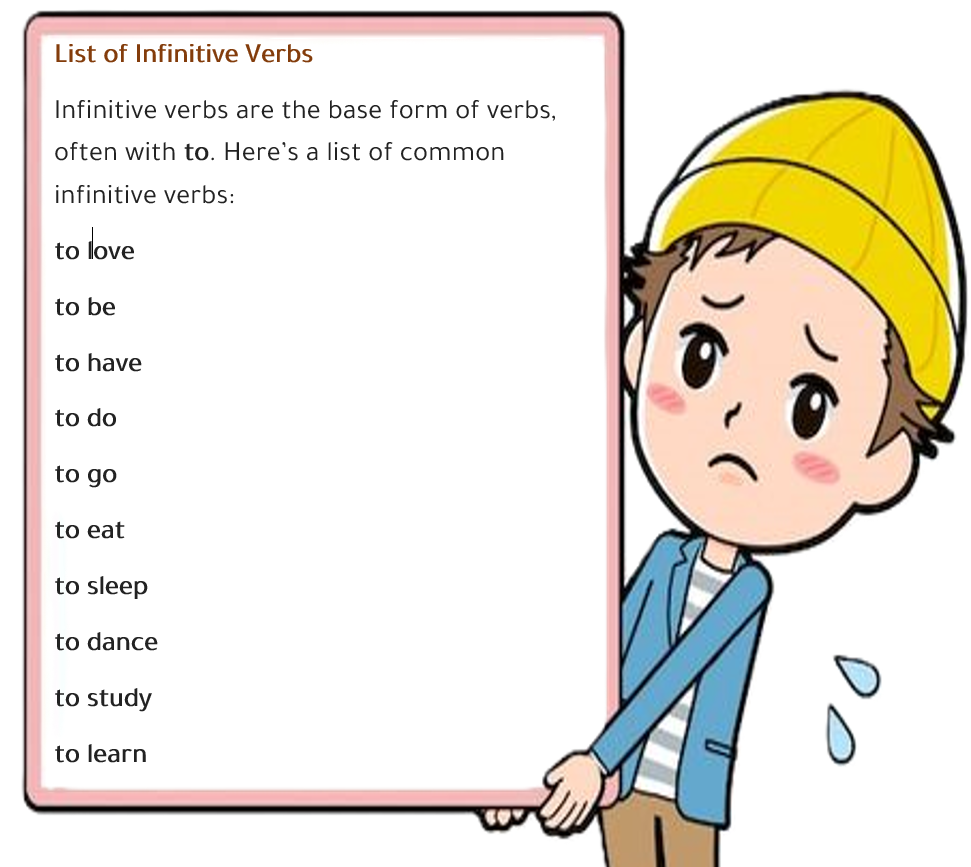
An infinitive verb is the base form of a verb, usually preceded by to in English, and it is not conjugated for tense, person, or number. |
|
Function of Infinitive Verbs infinitive verbs can serve many roles in a sentence, making them very versatile.
|
|
As the Main Verb After Adjectives She loves to dance. She is happy to assist.
As the Subject To Express Purpose or Intention To learn is important. I am studying hard to succeed.
As the Object of a Verb: With Modal Verbs He likes to play the guitar. He can run fast. They can swim. After Certain Verbs She agreed to help. I plan to visit the museum. |
Using infinitive verbs correctly means knowing their different roles in a sentence. Here are some guidelines:
1. Base Form
Use the base form of a verb, usually with to.
Example: She likes to dance.
2. After Modals
Use the bare infinitive after modal verbs (e.g., can, will).
Example: They can swim.
3. After Certain Verbs
Follow verbs like want or decide with the infinitive.
Example: She decided to study abroad.
4. After Adjectives
Use the infinitive after adjectives.
Example: It’s important to be honest.
5. As Subjects or Objects
Infinitives can be subjects or objects in a sentence.
What is a Gerund?
|
A gerund (often known as an -ing word) is a noun formed from a verb by adding -ing. Not all words formed with -ing are gerunds. |
1. As the subject or object of a sentence
· Collecting flowers is my hobby.
· I like collecting flowers.
2. After prepositions
· They are interested in studying archaeology.
. They dream of becoming archaeologists.
· They are crazy about discovering ancient cities.
. They are tired of digging in the sand.
3. After specific verbs such as:
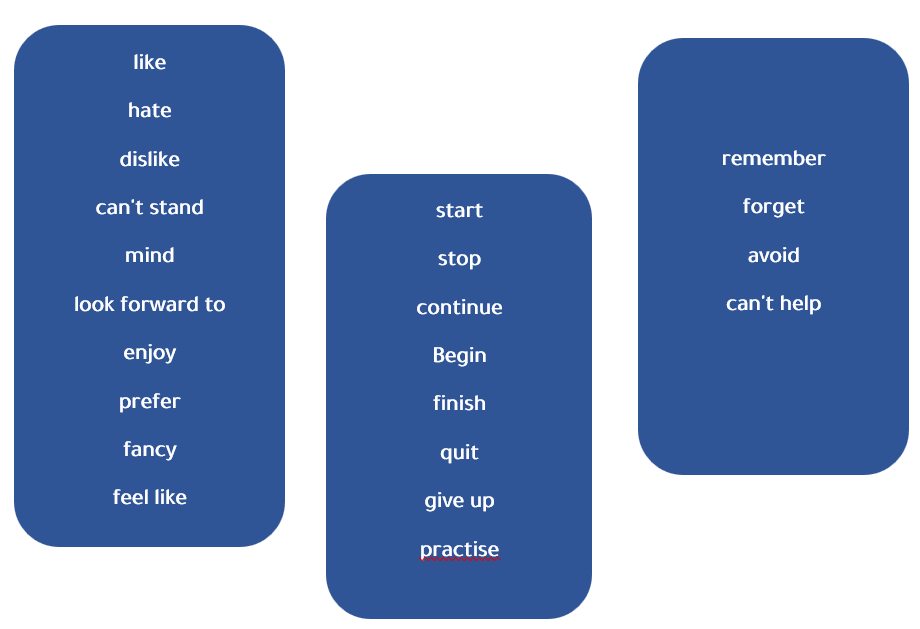
Examples
· I enjoy watching football on T.V.
· I hate travelling by coach.
. She started playing the guitar two years ago.
· He is trying to quit smoking.
· Do you remember buildings and castles when we were kids