Adverbs of manner explain how an action happens. They modify verbs.
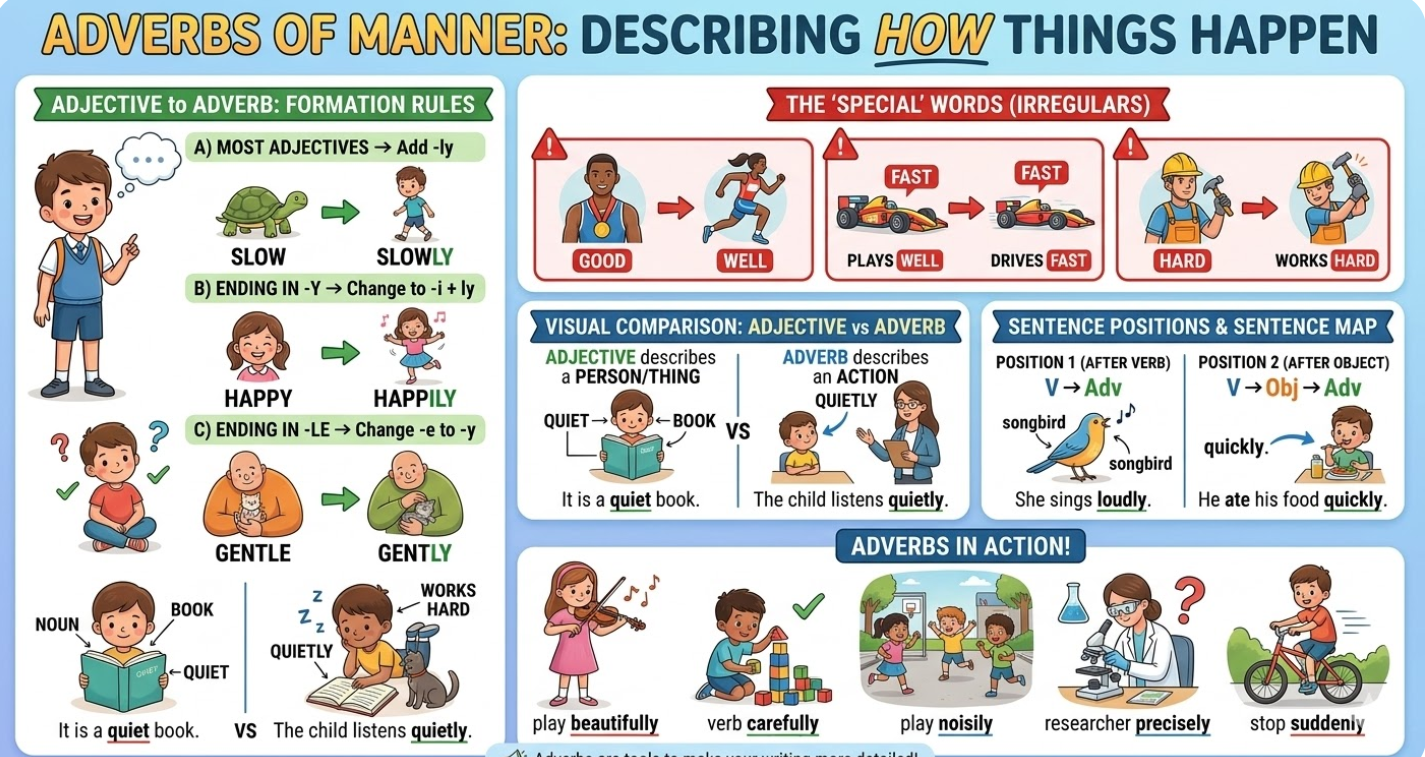
1. Formation Rules
| Adjective Ending | Rule | Example |
| Most Adjectives | Add -ly | Quick Quickly |
| Ending in -y | Change -y to -i + -ly | Happy \ Happily |
| Ending in -le | Change -e to -y | Gentle \Gently |
| Ending in -ic | Add -ally | Automatic Automatically |
2. The Irregulars
These do not follow the standard rules and must be memorized:
Good = Well ("He is a good singer" vs. "He sings well")
Fast = Fast (Never "fastly")
Hard = Hard (Note: "Hardly" exists but means "barely," not "with effort")
Late = Late (Note: "Lately" means "recently")
3. Sentence Position
Adverbs of manner usually appear in three places:
After the Verb: She walked slowly.
After the Object: He ate his dinner quickly.
Before the Verb (for emphasis): He quietly opened the door.
Rule: Never place an adverb between a verb and its direct object.
Incorrect: He ate quickly his dinner.
Correct: He ate his dinner quickly.
4. Adjective vs. Adverb
To choose the right word, ask: What am I describing?
-
Nouns: Use an Adjective. ("That is a loud bell.")
-
Actions: Use an Adverb. ("The bell rings loudly.")