1. Read the poem on Pupil’s Book page 22 again. Find and write words that rhyme.
1 website right 5 app map
2 alone phone 6 internet forget
3 more before 7 brighter lighter
4 down town 8 screen seen
2 Number the lines of the poem in order.
a 4 It will take you safely back home.
b 2 Try the blue and white one.
c 7 Why not read an e-book?
d 1 It’s better than my last phone.
e 6 You need some information.
f 3 It doesn’t take so much time.
g 5 The phone can take them better
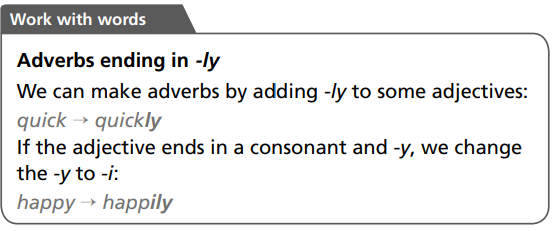
3 Read the Work with words box. Then write the adverbs.
Adverbs
Definition:
An adverb is a word that describes or gives more information about a verb, an adjective, or another adverb. It often tells us how, when, where, or how often something happens.
Explanation (Lesson – Adverbs ending in -ly):
- Many adverbs are formed by adding -ly to adjectives:
- quick → quickly (describes how something is done)
- If the adjective ends with a consonant + y, change y to i before adding -ly:
- happy → happily
- Adverbs tell how an action happens:
- She runs quickly.
- He speaks happily.
Key Points for Students:
- Adverbs often answer the question “How?”
- Most adverbs end in -ly, but some don’t (fast, well, hard).
- Check the adjective spelling before adding -ly.
1 easy easily
2 bad badly
3 quiet quietly
4 noisy noisily
5 careful carefully
6 slow slowly
4 Complete the sentences with the adverbs from Activity 3.
1 I’m not very good at reading maps. I get lost very easily!
2 Raed doesn’t talk a lot. He often sits quietly and reads.
3 My friend isn’t a good artist. She draws quite badly.
4 Adnan walks very slowly. I always have to wait for him.
5 Please cross the street carefully. Look both ways first!
6 The girls are playing noisily. They’re always so loud!