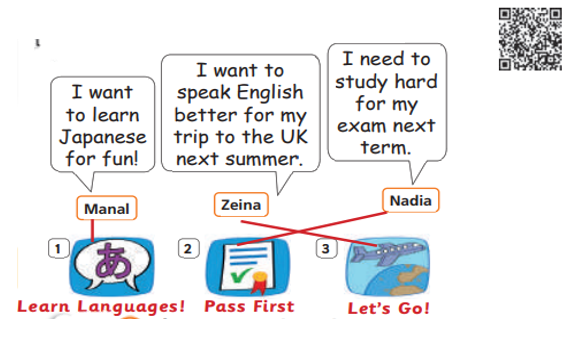
1. Look and match. Then listen, check and repeat.

2 Read the poem in Lesson 5 again. Find some phrases from Activity 1.
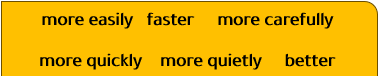
1 It does everything faster than before.
2 You can shop more quickly.
3 You can find your way more easily.
4 You can check facts more carefully.
5 It takes photos better.
6 You can do something more quietly lying on the sofa.
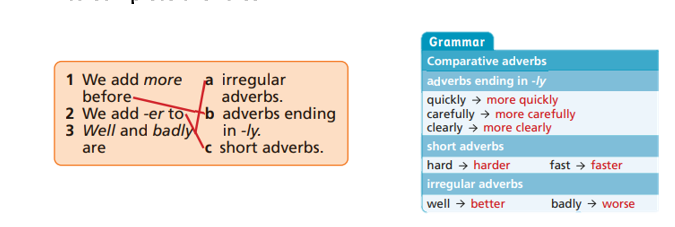
 Grammar
Comparative adverbs
Adverbs – Definition and Explanation
Definition:
An adverb is a word that describes or gives more information about a verb, an adjective, or another adverb. It often tells us how, when, where, or how often something happens.
Adverbs – How Actions Happen
- Adverbs ending in -ly
- Made by adding -ly to adjectives:
- quick → quickly
- happy → happily (change y → i)
- Use: Describes how an action happens.
- She types quickly.
- Short adverbs
- Some adverbs don’t need -ly: hard → harder, fast → faster
- Use: Also to describe how an action happens.
- Irregular adverbs
- Well → better, badly → worse
- Use: Some adverbs have special forms in comparisons.
Key Points for Students:
- Adverbs often answer the question “How?”
- Most adverbs end in -ly, but some don’t (fast, well, hard).
- Check the adjective spelling before adding -ly.
Comparative Adverbs
- Use: Compare actions between two people or situations.
- Examples:
- She types faster than her brother.
- He runs more quickly than me.
- Rules:
- Add more for adverbs ending in -ly → carefully → more carefully
- Add -er for short adverbs → fast → faster
- Irregular adverbs → well → better
- 4 Read the grammar table. Then match the sentence halves to complete the rules.
- 5.Listen. Match the children with the apps.