1 SPEAKING In pairs, discuss the questions.
1 Do you prefer to watch a fi lm, a TV series or go to the theatre? Say why.
2 What are the advantages of each form?
Answers Students’ own answers
2 Read the Articles Wanted! notice. Do you agree with what the author says about watching box sets? Say why.
ARTICLES WANTED!
A recent magazine article claimed that watching box sets on TV is a mindless form of entertainment which takes up too much of young people’s time. Write an article in response to this view in which you review a box set you have seen and say why you think this form of entertainment is worthwhile.
Answers Students’ own answers
3 A good title is an important part of making an article engaging. In pairs, decide what title you would give the article you are writing.
Answers Students’ own answers
4 What does a writer do to engage your interest? Find examples of some of these techniques in the article below.
• Grabbing the reader’s attention at the beginning of the article.
• Addressing the reader directly.
• Giving personal opinions.
• Giving concrete examples.
• Using a range of interesting vocabulary.
• Using emphatic structures
Answers
Grabbing the reader’s attention at the beginning of the article – the title ‘Is TV ‘chewing gum for the eyes’? Addressing the reader directly - ‘If you don’t believe me, start watching Fisherman.’ Giving personal opinions - ‘I was blown away by the performance of Lewis Owen...’ Giving concrete examples - ‘Just to give one example: I recently watched Fishermen series...’ Using a range of interesting vocabulary - compelling viewing, blown away by, breathtaking (accept other examples) Using emphatic structures - I do know I’m way behind
5 Find and underline phrases from the Writing box in the article.
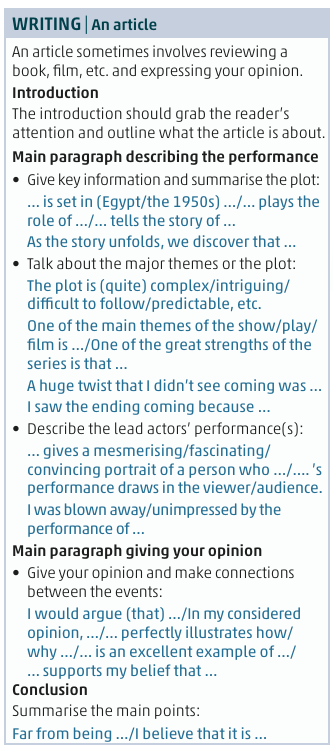
Answers
Introduction
The introduction should grab the reader’s attention and outline what the article is about.
People used to think TV was ...but in recent years I would say...
Main paragraph describing the performance
• Give key information and summarise the plot:
The series tells the story of a young fi sherman, William Kyle, and his family who live by the sea.
• Talk about the major themes or the plot:
Each episode has a diff erent storyline, but the main characters remain the same. In series 1 there are also sub-plots that run through the diff erent episodes throughout the series ...
• Describe the lead actors’ performance(s):
I was blown away by the performance of Lewis Owen ...
I was particularly impressed by the quality of his acting skills, which are breathtaking. I shouldn’t have been surprised as he has won lots of awards for his acting...
Main paragraph giving your opinion
• Give your opinion and make connections between the events:
I was blown away by.../ I was particularly impressed by.../ Although I sometimes struggled to follow the plot, the series certainly entertained me... / ...an excellent example of... / I would argue... (that)
Conclusion
Summarise the main points: Far from being …/I believe …
6 Read the article again and find synonyms for these words which the writer used to avoid repetition.
1 performance
2 series
3 excellent
4 story
Answers 1 acting 2 programme 3 breathtaking 4 plot
7 Study Watch Out! and completethe text with one, so, such or a pronoun.
The character Oliver is the 1 ...................we identify with right from the start of Dickens’s novel Oliver Twist. As the novel develops, we meet other children and start to relate to 2 .................too, even though they are thieves. We sympathise with them because we can understand that 3................. upbringing made them the way they are, and 4................... a childhood would affect anybody negatively. We keep hoping that Oliver will escape from the thieves, and when he fi nally does 5..................... , we can all breathe a sigh of relief.
WATCH OUT!
In both speaking and writing, we usually try to avoid repetition of the same words or phrases.
• We can use pronoun reference, replacing a noun or noun phrase with a pronoun.
• We can replace a noun or noun phrase with one, ones, both or some.
• We can replace a verb phrase with an auxiliary verb (do, be, have) and sometimes with an auxiliary + so or the same.
• We can also use such before a or an or after expressions the fi rst, the only to substitute for a clause meaning ‘of this or that kind’.
Answers 1 one 2 them 3 their 4 such 5 so