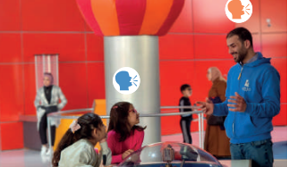
Welcome to the museum! Is this your first visit?
Yes, it is! We learned about the Romans at school last week.
Was it interesting?
Yes, very. I want to find out more! Can you tell me where the Roman room is, please?
Yes, of course. It’s upstairs. Go through that door, then take the escalator to the first floor. It’s the second door on the right.
Thank you. And what about the café? Where’s that, please?
Oh, that’s easy – it’s on the ground floor! Go along the corridor and around the corner. The café is next to the exit.
That’s great. Thanks very much.
Enjoy your visit!
Grammar and Usage
- Use imperative form for giving instructions:
- “Go through that door.”
- “Take the escalator to the first floor.”
- Use prepositions to indicate location:
- “Next to the exit.”
- “Around the corner.”
- “Along the corridor.”
- Use asking phrases to get directions:
- “Can you tell me where the Roman room is, please?”
- “Where’s the café?
Vocabulary – Giving Directions
|
English |
Meaning in English |
Arabic Meaning |
|
upstairs / downstairs |
go to a higher/lower floor |
الطابق العلوي / الطابق السفلي |
|
left / right |
directions |
يسار / يمين |
|
first / second / ground floor |
floors in a building |
الطابق الأول / الثاني / الأرضي |
|
corridor |
hallway |
ممر |
|
around the corner |
turn at a corner |
حول الزاوية |
|
go through the door |
pass the door |
عبر الباب |
|
along the corridor |
move following the corridor |
على طول الممر |
|
lift / escalator |
elevator / moving stairs |
مصعد / سلم متحرك |
|
next to |
beside |
بجانب |
|
exit |
way out |
مخرج |

1. Listen and read. Answer the questions.
1 Why did the girl go to the museum? Because she learned about the Romans at school and now wants to find out more.
2 What two places does she want to find? the Roman room and the café
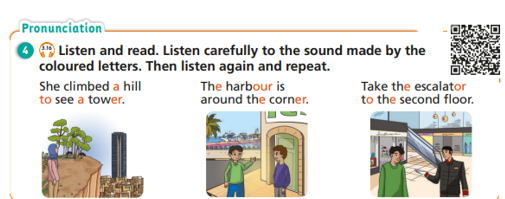
Pronunciation
We are focusing on stressed and unstressed words in sentences.
- Understanding Stress in Words and Sentences:
- In English, some words or syllables are stressed, meaning we say them louder, longer, or with a higher pitch.
- Other words or syllables are unstressed, which are said softer and faster.
- Example: “She climbed a hill to see a tower.”
- Stressed words: climbed, hill, tower
- Unstressed words: a, to, see
- The Schwa Sound:
- Unstressed syllables often have a special short vowel sound called the schwa /ə/.
- It sounds like a soft “uh.”
- Example: “a tower” → “a” is pronounced /ə/, not like the letter “a” in isolation.
- This happens in articles, prepositions, conjunctions, pronouns, and auxiliary verbs.
- Rhythm in English:
- English has a natural rhythm: stressed words carry the main meaning, unstressed words connect the meaning.
- Listening carefully helps you read more fluently and sound natural.