1 2.1 Listen to three people talking about unusual things they have seen on journeys and answer the questions.
1 Which photo is each speaker talking about?
2 What did each speaker see that was unusual?
3 What does each speaker say about their own behaviour when travelling?
4 How do the speakers explain the events?
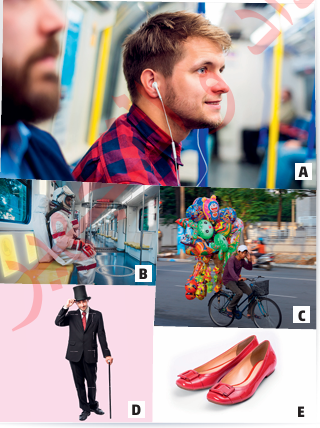
Answers
1 S1: D, S2: E, S3: C
2 S1: two exceptional-looking people: the old-fashioned British man, the man with the gold suit; S2: a pair of women’s shoes in decent condition; S3: a mass of brightly coloured balloons, fastened to a bike
3 S1 likes to watch people when travelling. S2 avoids rush hour - runs up to last train carriage. S3 checks out car/ motorbike makes on long car journeys.
4 S1: gentleman = campaign supporter; S2: sore feet / new pair of shoes; S3: The man was planning to sell the balloons
Verbs of movement
2 For each sentence, choose the correct form of the verb of movement from the recording to complete it.
1 After hurting his ankle, the footballer......................off the pitch to get some help.
a hobbled b strode c surged
2 As soon as the train arrived, the crowd........................forward to try and get on it as quickly as possible.
a wobbled b shuffled c lurched
3 My brother and I lifted up the sofa with some difficulty and.....................across the room with it. It was far heavier than we expected.
a strode b staggered c surged
4 I woke my sister up when I came home and, while still half asleep, she.....................out of her bedroom and asked me where I had been.
a shuffled b strode c lurched
5 Angry at having to wait for so long, my father.......................up to the manager and demanded an explanation.
a shuffled b hobbled c strode
6 Mariam...................into the room with a tray of tea and cake, terrified of dropping it on the expensive carpet.
a strode b wobbled c surged
7 Shortly after the fi re alarm went off , the workers...................out of the office looking very worried.
a surged b shuffled c wobbled
Answers
1 a 2 c 3 b 4 a 5 c 6 b 7 a
Idioms related to movement
3 Study Active Vocabulary. Then complete the sentences with the words from the box.
| boat downhill force plain ride steer wall |
1 There are new roadworks in the town centre, and it is driving motorists up the........................So you’d better.................clear of the main junction for at least a week.
2 He encountered some obstacles while training to become a pilot. It wasn’t all....................sailing.
3 It was because of Suha’s commitment that the new rail project was successful. She was the driving......................behind it.
4 The airline used to have an excellent reputation, but in recent months, it’s been going....................quickly.
5 Everyone’s furious about the increase in car parking fees. We’re all in the same........................– we have no other option. We know the city needs money, but no one likes to be taken for a............................
Answers
1 wall, steer 2 plain 3 force 4 downhill 5 boat, ride
|
ACTIVE VOCABULARY| Idioms Idioms have a figurative meaning. For example, completely at sea with the new computer system means I’m totally confused or not sure what to do with it. • Idioms are used mainly in informal or colloquial language. • It is important not to change any word in an idiom or the meaning is lost. • It is better not to overuse idioms, as this can sound unnatural. |
|
WATCH OUT! Some verbs, apart from having a literal meaning, also have a fi gurative one. For example, the literal meaning of to fly is to move in the air, and its figurative meaning is to move quickly and suddenly, e.g., I saw an opening in the crowd and flew down the platform. |
Travel verbs
4 Study Watch Out! and give both a literal and figurative meaning of the verbs in the box. Then complete the sentences with the correct forms of these verbs. Use a dictionary if necessary.
| backpedal drive fly jump park sail stagger stumble |
1 Reem........................... through her interview to become a tour guide.
2 My cousin.........................himself too hard in his work as a holiday rep and he’ll be ill if he’s not careful.
3 I was so stressed while reading the speech that I..................over some of the words.
4 We were.........................by the amount of work the children did for their exam.
5 I was late this morning and I..........................down the road to catch the bus with a few seconds to spare.
6 No one can agree about whether or not to install speed bumps, so let’s just............................that idea for now.
7 He was in such a hurry that he..............................the lights and nearly had a crash.
8 The man was about to tell us not to park outside his house when he realised we were police offi cers. He.....................very quickly!
Answers
1 sailed 2 drove 3 stumbled 4 staggered 5 fl ew 6 park 7 jumped 8 backpedaled
5 SPEAKING In pairs, choose one of the photos on page 14 not referred to in the recording and invent a story about a traveller seeing these events. Use the verbs from Exercise 4. Tell your story to the class.
Answers
Students’ own answers