Unit 4
Lessons 5 and 6
Student’s Book pages 36-37

READING AND COMPREHENSION
1 Look at the photographs. Who are these people? What are they doing?
Suggested snswers
They are students, and they are graduating.
2 Read the words in the box. Check the meaning of any words you don’t know in the Activity Book Glossary or in a dictionary. Then, write sentences using these words.
|
higher education vision distinguished witness priority |
Answers
Students’ own answers
3 Read the article. How objective is the speaker? Explain.
JORDAN, A PIONEER IN HIGHER EDUCATION
Jordan has some of the best universities in the Middle East, both public and private. In the last two decades, and during the reign of His Majesty King Abdullah II, the sector of higher education in Jordan witnessed significant progress.
His Majesty King Abdullah II had a vision to transform Jordan into a leading country in the global economy, and so he placed higher education within the priorities of the country.
In 2007 CE, His Majesty King Abdullah II established the Scientific Research Support Fund for encouraging and supporting scientific research in the kingdom. The SRSF helps distinguished students through offering scholarships and supporting their higher education research programmes.
During his Majesty’s reign, many public and private universities were established. There are some 236,000 students studying in Jordan’s universities, including 28,000 foreign students from all over the world. Jordan has one of the best standards of education in the Arab region, and, without a doubt, a pioneer in higher education.
Answers
The speaker is not objective because he gives his opinion about education in Jordan. - Jordan has some of the best universities……. Jordan is one of the most educated countries in the Arab region……… a pioneer in higher education-.
4 Read the article again and answer the questions.
1 What is the main idea of the text?
2 Why is Jordan considered a pioneer in higher education?
3 In your opinion, why do foreign students come to study in Jordan?
4 Discuss how higher education progressed during the reign of His Majesty King Abdullah II.
5 Give suggestions about how higher education could be developed further in Jordan.
Answers
1 The speaker explains to the reader how Jordan is one of the most educated countries in the Arab region.
2 Many native students, as well as foreign students from all over the world, go to study in Jordanian universities.
3 Students’ own answers
4 His Majesty King Abdullah II established the Scientific Research Support Fund for encouraging and supporting scientific research in the kingdom. The SRSF helps distinguished students through offering scholarships, and supporting their higher education research programmes in Jordan.
5 Students’ own answers
PRONUNCIATION
5 Can you say this proverb? Use the pronunciation table in your Activity Book Glossary to help you.
/ə tʃaɪld wɪˈðaʊt edʒʊˈkeɪʃ(ə)n ɪz laɪIk ə bɜːd wɪˈðaʊt wɪŋz /
What do you think this proverb means? Translate it into Arabic, then in pairs compare your answers.
Answers
“A child without education is like a bird without wings”
SPEAKING
6 What would you like to study at university? Discuss with a partner.
Students’ own answers
WRITING
7Paraphrase the first two paragraphs in the article on page 36. Then share your work with the class.
Students’ own answers
READING
8 The way humans react is fascinating, and it is a growing area of scientific research. Read the instructions for this experiment. Then work in pairs and carry it out. Make notes about your findings.
Experiment – How fast do you react?
1. Ask a partner to hold up a ruler. His or her hand should be at the top. Put your hand close to the zero mark at the bottom. Don’t touch the ruler!
2. Ask your partner to drop the ruler suddenly. Try to catch it.
3. Look where your hand is on the ruler. Write down the number next to your hand. It shows how far the ruler has fallen.
4. Repeat the experiment three more times. Can you catch the ruler faster each time? Look at the numbers you write down to find out.
Students’ own answers
Writing strategies
Writing a report
• Your report should tell the reader what happened in the experiment and what the experiment showed.
• Use the information in exercise 8, but try not to copy. Use your own words. Use short, simple sentences.
WRITING
9 Read What’s happening? below. Use this information and your notes from exercise 8 to write a short report about your experiment. Then share your work with the class.
What’s happening?
Experiment – How fast do you react?
You catch the ruler when a message travels from your eyes to your hand. It takes a short time for this to happen. You can catch the ruler faster with practice, but the message always needs time to travel.
Students’ own answers
Unit 4
Lessons 5 and 6
Activity Book page 26-27
READING
Look at the first paragraph of the text. What theory do you think the text is going to explore?
8 Read the text and check your answers. Do you want to improve your study skills or write a book?
Do you want to become a distinguished student? Surrounding yourself with the right colour might help!
The question of the effect colour has on the brain has always amazed scientists. Many have witnessed that red makes people feel stronger and more powerful, specifically the deep red colour.
In a study, researchers at a top university carried out tests on 600 people to see how well they used their skills. They were trying to test their hypothesis that the colour red or blue affects us in different ways. The findings showed that people could remember details better when they looked at images against a red background, for example, a computer screen. On the other hand, they were able to be more creative when the background colour was blue.
The hypothesis is that red, which is connected with emergency and warning (fire engines, traffic lights, etc.), makes people feel more alert, and so they are able to pay attention to detail. Blue is a relaxing colour, which helps to bring out people’s creativity.

9 Answer the following questions.
1 How did scientists carry out their research?
2 According to the report’s findings, which would be a better background colour for someone revising for a science test? Why?
3 According to the report’s findings, which would be a better background for someone writing a poem? Why?
4 Why do people respond to red with more focus and attention to detail?
5 What type of red is likely to make people feel stronger and more powerful?
6 Do you agree with the research you have read about? Why?
VOCABULARY
10 The following words are found in the text you just read. Find them and write their definitions. Then, write your own sentences using these words.
1 distinguished:
2 witness:
3 hypothesis:
WRITING: A REPORT ABOUT YOUR OBSERVATIONS FROM AN EXPERIMENT
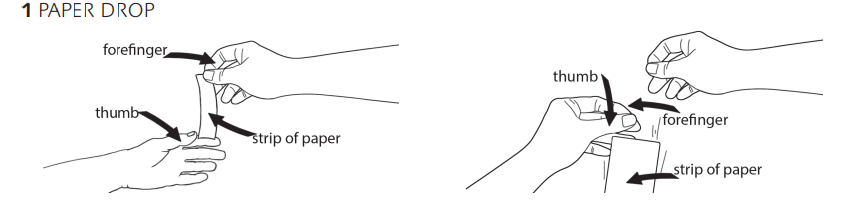
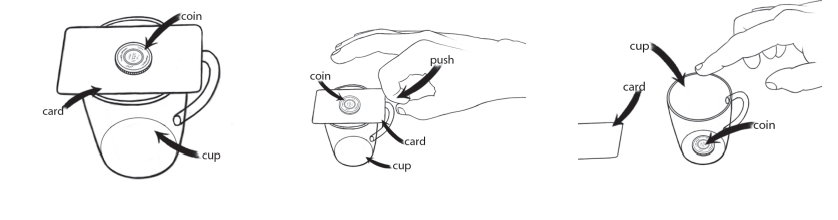
11 Work in pairs. Carry out the following experiments with paper. Use the pictures and the words to describe the experiments.
Page 26, Exercise 7 Students’ own answers
Page 26, Exercise 8 The text explores the theory that having the right colours around you when you study might help.
Page 26, Exercise 9
1 Scientists carried out tests on 600 people.
2 Red; it makes you pay attention to detail.
3 Blue; it helps you to be more creative.
4 Red is associated with emergencies and warnings.
5 Deep red is likely to make people feel stronger and more powerful.
6 Students’ own answers
Page 26, Exercise 10 1 distinguished: line 3 – successful, respected and admired
2 witness: line 7 – to have knowledge of something from personal observation and experience
3 hypothesis: line 21 – a suggested idea that is not yet proved Students’ own answers
Page 27, Exercise 11
1 We carried out an experiment dropping a slip of paper between our thumb and forefinger. The aim was to find out whether our brains were able to react quickly enough to catch the paper before it dropped. To carry out this experiment, two people were needed – one to drop the paper, and the other to try to catch it. The experiment was set up other to try to catch it. The experiment was set up by carefully placing the lower end of the paper strip between one person’s open thumb and fingers, and then letting it go. It was difficult to catch the paper as it fell too quickly.
2 The next experiment used a cup, a coin and a playing card. The aim of the experiment was to find out what happened to the coin when we pushed the card. The coin was placed in the centre of the card, and these two items were placed on the cup, which was standing the correct way up. When the apparatus had been set up, the card was pushed across the cup, length-ways, until it fell off the other side of the cup. The coin fell into the cup – it did not stay on the card.
Page 27, Exercise 12
1 Our brains are too slow to send a message to our fingers, to catch the paper when it drops.
2 The coin proves that objects in one place want to remain in that place. This is called inertia.