Unit 7
Lessons 3+4
Student’s Book pages 58 and 59
Speaking
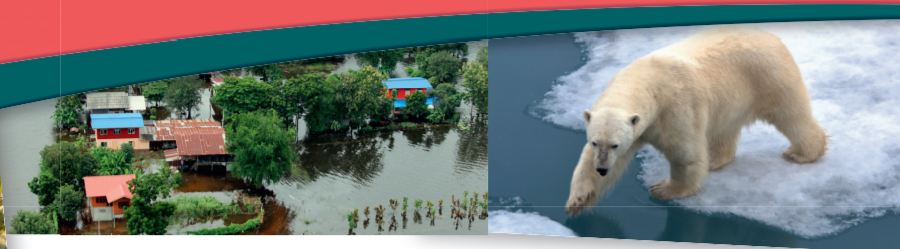
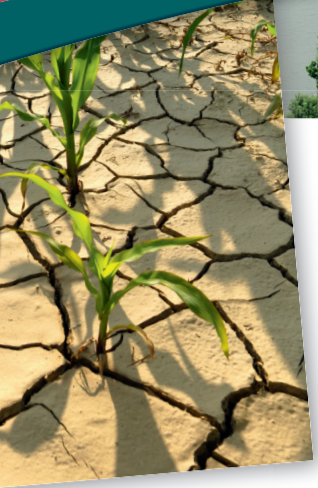
1 Look at the photographs. What do they show? Discuss with a partner.
Answers
The photographs show a draught, a flood, and the melting of ice.
VOCABULARY: Climate change
2 Which of these words and phrases are connected with climate change? Check the meaning of any words you don’t know in the Activity Book Glossary or in a dictionary.
|
global warming greenhouse gases drought flood atmosphere rise in temperature rise in sea levels melting ice damage to crops |
Answer
All of these words are connected to climate change.
LISTENING
3 Listen to the radio programme. What is the difference between weather and climate?
4 Listen again and answer the questions.
1 What is the main idea of the audioscript?
2 What is described as a ‘giant blanket of air’?
3 What negative impact can weather have on Earth?
4 What causes global warming? What can people do to reduce it?
5 What do you think will happen to the world’s climates in the future?
Audioscript
The weather and climate affect the way you dress, the food you eat, and the place where you live. The weather can create huge waves at sea and shape the Earth around us. Plants and animals around the world have adapted to weather conditions that they live in. For example,polar bears in the Arctic have thick fur to protect them from cold.
The atmosphere which surrounds Earth is like a giant blanket of air. The weather is something that is happening at the moment in the atmosphere. The weather is also affected by things that happen thousands of kilometres away.
The weather creates many of the world’s worst disasters, such as droughts, which cause crops to die and animals to starve, and floods, which cause widespread destruction. However, thanks to modern science, weather forecasts are now fairly accurate worldwide.
Today, though, world climates are changing faster than ever before. This is the result of global warming, which is caused by a build-up of greenhouse gases, the world will become hotter, and extreme weather will become more common.
Answer
The weather is something that is happening at the moment in the atmosphere. When a type of weather affects a part of Earth for many years, it is called climate.
WRITING
5 Listen to the radio programme again. Then write a summary of the programme using the words in the box in exercise 2.
Answers
Students’ own answers
SPEAKING AND WRITING
6 Fill in the blanks with the words from the box to complete the following poem. Discuss its meaning. Then, recite it to the class.
|
mighty sand ocean Humble drops water grains eternity |
Little………. of…………… ,
Little………. of…………. ,
Make the mighty…………
And the pleasant land.
Thus the little minutes,
………….though they be,
Make the…………. ages
Of……………. .
Answers
Little drops of water ,
Little grains of sand ,
Make the mighty ocean
And the pleasant land.
Thus the little minutes,
Humble though they be,
Make the mighty ages
Of eternity.
7 Write your own poem about a topic of your choice. Then, recite it to the class.
Answers
Students’ own answers
VOCABULARY: Climates
8 Write the descriptions in the box under the correct types of climates.
|
|
Answers
|
Polar |
Tropical |
Desert |
Monsoon |
Cool temperate |
Tundra |
|
|
hot and wet |
hot in the day, cold in the night |
very heavy rain |
rain most of the year |
very little rain |
|
ice and snow |
|
very little rain |
|
not very cold winters |
very short summers |
PRONUNCIATION
9 Listen to the words in the box. What do they have in common? And in what way are they different? Listen again and repeat.
|
Jordan valley Russia North America North Africa Southern Europe South America Jordanian Badia South-East Asia Central Australia India Northern Europe |
Put the words in alphabetical order.
Answers
All the worlds refer to places. Some refer to areas in countries (Jordan valley, Jordanian Badia), some refer to continents (North America, North Africa, Southern Europe, South America, Northern Europe, Central Australia, South-East Asia) and the others refer to countries (Russia, India).
Alphabetical order: Central Australia, India, Jordan valley, Jordanian Badia, North Africa, North America, Northern Europe, Russia, South America, South-East Asia, Southern Europe).
10 Complete this report about desert climates with the words from the box.
|
survive cold |
Desert climates
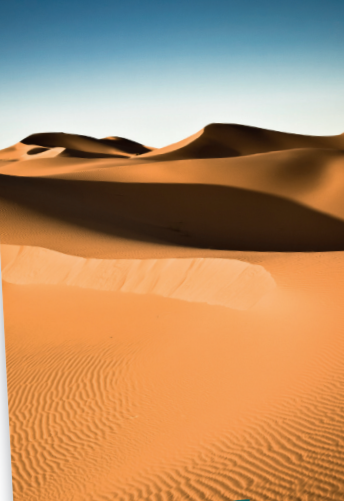
Around 20 percent of the (1) surface of Earth is desert. Climates in the desert are either hot or (2)……………. . The Jordanian Badia desert reaches 80 percent of the total area of the Kingdom. However, Jordan is among the few countries that have a (3)……………….. climate, but that also enjoy mild to cool and wet (4)…………………… . That’s why we find Aqaba city and Jordan valley hot in summer and warm in winter. The Badia desert is rich in wildlife. In the 1920’s, some animals like the Arabian oryx didn’t (5)………………….. due to climate change and the small amount of (6)………………. . As a result, the Jordanian authorities set up the Shaumari Reserve in 1975 CE to save the few remaining numbers of the Arabian Oryx.
Answers
1 surface
2 cold
3 desert
4 winters
5 survive
6 rainfall
Research box
Global warming is due to greenhouse gases. How is Earth like a greenhouse?
(a greenhouse lets the Sun’s heat in through the glass but keeps most of it inside the glass, so it warms up. Greenhouse gases in Earth’s atmosphere also traps a lot of the Sun’s heat and stops it from escaping into space).
Unit 7
Lessons 3+4
Activity Book page 41
VOCABULARY
5 Listen to Jordan’s weather forecast, and then complete the sentences.
1 In Amman, the weather tomorrow is expected to be………………….. . So, put on your jackets everyone!
2 Don’t forget your umbrellas tomorrow! There will be some………………….. and light ……………………. in Amman.
3 It will be a little hotter in Aqaba, with lots of…………………. . So, why don't you go out and enjoy the nice weather?
4 For those who live in Jerash, be careful tomorrow! A strong……………………. is on its way there!
1 cold
2 clouds, rain
3 sun
4 wind
6 Complete the sentences about climate change with the words from the box.
|
global Greenhouse droughts flood atmosphere temperatures sea levels crops |
How the world’s climate is changing
● The (1)……………. is rising all the time, and Earth is becoming hotter.
● Melting ice causes a rise in (2)………………………. .
● (3) gases in the world’s (4)…………………… lead to (5)…………………. warming.
● Long periods without rain are called (6)…………………… . They can cause damage to (7)…………………….. .
1 temperature
2 sea levels
3 Greenhouse
4 atmosphere
5 global
6 droughts
7 crops
WRITING
7 Read Hamid’s notes to find out how the kind of food we eat affects the environment. Then, answer the question below.
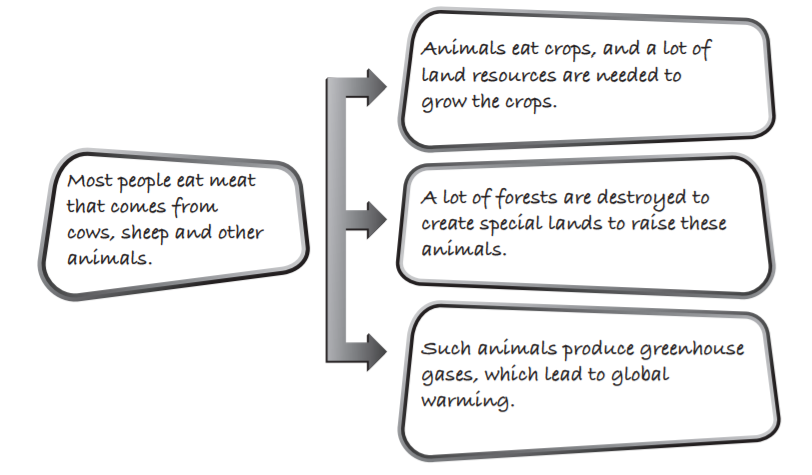
After reading Hamid's notes, what conclusion can you come up with? Justify your answer.
Students’ own answers