1 Read the text and answer the questions.
1 What type of text is it? Where might you read it?
2 Would you want to have the same experience? Why/Why not?
Answers
1 A personal account - a blog post or a diary entry
2 Students’ own answers
Speeding in the sand
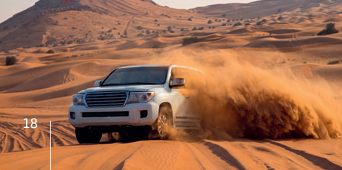
The day when I finally got to go to the desert had finally arrived! My family had arrived in Dubai on holiday just two days before. Never before had I experienced such intense heat, as it was my first time in the Middle East. What I was really wild about though, was seeing the desert for the first time. I had only ever seen it on television and I was fascinated by it. Early on the morning of the third day, we set off with our guide, Saeed. It wasn’t long until the buildings started to disappear and the desert laid out before us. Never had I imagined such beauty. It was the flowing golden dunes which really impressed me. Little did I realise how differently I would feel about them soon. We were there to try ‘dune bashing’ and Saeed took us to a car especially equipped for the sport. We quickly strapped ourselves in. What followed was the ride of a lifetime. We surged up the dunes at angles that made me think we were sure to roll over. Only when we reached the top did I realise how high the dunes were. It was Dad who said it was like a rollercoaster without the feeling of safety! I agreed with him. Mum just laughed in fear for the entire ride. Rarely have we had such a crazy experience as a family. Between the amazing scenery and the high speeds, we got a real kick out of it. It was a day we will never forget.
Inversion and cleft sentences
2 Look at the sentence from the text and one which has a similar meaning.
1 Never before had I experienced such intense heat.
2 I had never experienced such intense heat before.
Answers
The first sentence is an example of negative inversion. It is used to emphasise a negative adverb or adverbial expression and to make a sentence sound more dramatic or memorable.
Examples: Never had I imagined such beauty. Little did I realise how diff erently I would feel… Rarely have we had such a crazy experience…
3 Compare sentences from the article (a) with sentences which mean the same (b). How are they diff erent?
1 a Only when we reached the top did I realise how high the dunes were.
b I only realised how high the dunes were when we reached the top.
2 a It was the flowing golden dunes which really impressed me.
b I was really impressed by the flowing golden dunes.
Answers
The word order is diff erent. What is emphasised:
1 Only when we reached the top did I realise…
2 It was the fl owing golden dunes which…
4 Match options a of sentences 1 and 2 from Exercise 3 with explanations a and b below.
a □ To add emphasis, we can begin sentences with negative adverbials, such as Seldom and Rarely or words like Only, So, and Such. We call this inversion.
b □ We can use cleft sentences to emphasise information in a sentence and make it sound more memorable. These often begin with What, It’s, etc.
Answers
a 1 b 2
5 Study Watch Out! Then read the text again and find:
• four more examples of cleft sentences.
• two more examples of inversion.
Possible answers
Cleft sentences: The day when I finally got to go to the desert had finally arrived!; What I was really wild about though, was seeing the desert for the first time.; What followed was the ride of a lifetime.; It was Dad who said...; It was a day we will never forget.
Inversion: Little did I realise how differently I would feel…; Rarely have we had such a crazy experience as a family.
6 Rewrite the sentences from Exercise 5 in normal word order.
Answers
Cleft sentences: The day had arrived when I finally got to go to the desert.; I was really wild about seeing the desert for the first time,; The ride of a lifetime followed.; Dad said that ...; We will never forget that day.
Inversion: I didn't realise how differently I would feel.; We have rarely had such a crazy experience as a family.
7 Rewrite the sentences using inversion. Start with the words in bold.
1 He never felt sorry for himself. NOT ONCE
2 He didn’t know what was going to happen. LITTLE
3 She was so happy that she thought she would never stop smiling. SO
4 The speed was so great that they started to feel scared. SUCH
Answers
1 Not once did he feel sorry for himself.
2 Little did he know what was going to happen.
3 So happy was she that she thought she would never stop smiling.
4 Such was the great speed that they started to feel scared.
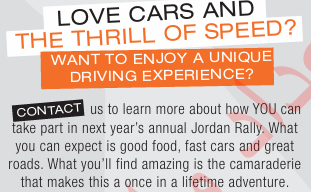
8 Read the advert about the Jordan Rally. Have you heard of rallies like this? What might they involve?
Answers
Students’ own answers
9 Look at cleft sentences 1a and 1b. Which information is emphasised? Rewrite sentences 2–4 in a similar way.
1 The camaraderie is amazing.
a It’s the camaraderie that’s amazing.
b What you’ll find amazing is the camaraderie.
2 You can expect good food, fast cars and great roads.
a It’s.........................................................
b What.....................................................
3 A passion for cars unites the group.
a It’s .............................................
b What..........................................
4 Speed is the thing that makes me excited.
a It’s ..........................................................
b What.........................................................
Answers
2 a It’s good food, fast cars and great roads that you can expect.
b What you can expect is good food, fast cars and great roads.
3 a It’s a passion for cars that unites the group.
b What unites the group is a passion for cars.
4 a It’s the speed that makes me excited.
b What makes me excited is the speed.
|
WATCH OUT! Cleft sentences start not only with It’s and What, but can also start with The (only) thing that, The day when, The place where, The reason why or The person/people who, e.g., The only thing that unites the group is a passion for cars. The person I want to see is you. The day when I learnt how to use cleft sentences was the best day of my life! |